What Determines Leak Detection & Waterproofing Costs? An Engineering Guide to Comparing Quotes Fairly
When requesting quotes for water leak diagnostics, roof waterproofing, or concrete tank lining in the Eastern Province, property owners often receive widely different numbers with minimal technical detail. This buyer’s guide breaks down the real engineering variables that drive project cost—and shows you how to evaluate contractor proposals on specification depth rather than headline price alone.
Key Engineering Takeaways
- For leak diagnostics, inspection effort scales with plumbing complexity—number of tanks, booster pumps, hot/cold manifolds, and affected floors.
- For roof and tank waterproofing, mechanical surface preparation, 45° corner detailing, and UV/potable protective coats represent a major share of lasting performance.
- Fair quote comparison requires matching chemical family, membrane thickness or foam density, coat count, primer inclusion, and flood testing.
- Unusually low teaser quotes typically skip substrate grinding, thin down liquid coverage rates, or omit mandatory UV protective topcoats.
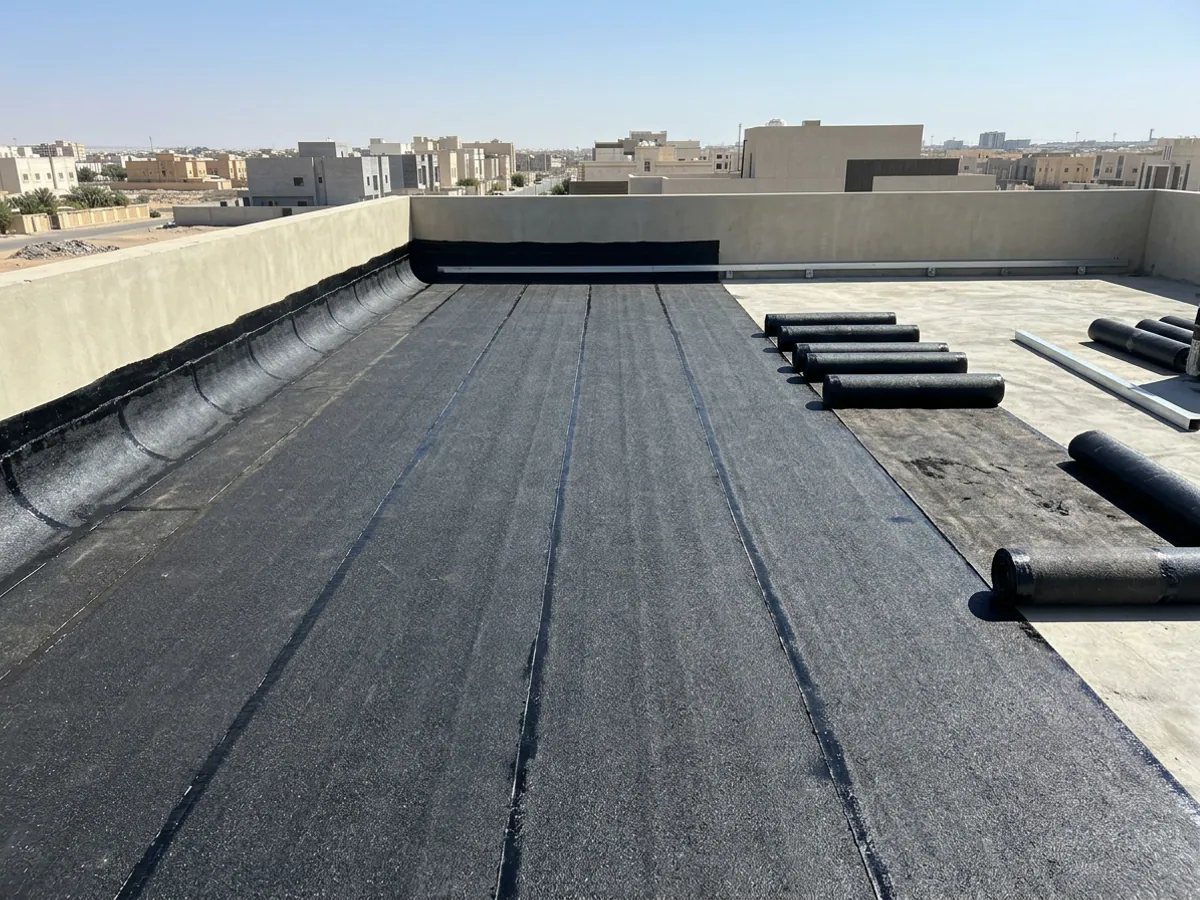
Teaser Per-Meter Quotes vs. Complete Building-Envelope Assemblies
Building diagnostics and waterproofing are not off-the-shelf commodities. Two villa roofs with identical floor area can require completely different scopes: a clean new concrete slab needs standard priming and membrane installation, whereas an aging tiled roof with ponding water may need delaminated layer removal, polymer-mortar crack repair, drain recessing, and hand-flashing around twenty AC plinths.
Consistent with Manar Al Sharqiya’s transparent engineering approach across water leak detection, waterproofing, and thermal insulation, this guide explains every technical variable that shapes a realistic project scope.
- Dry film thickness (DFT), roll weight, and foam core density determine how much protective material actually sits on your slab.
- Skipping primer coats, 45° cant strips, or UV elastomeric topcoats lowers upfront cost while causing premature membrane failure.
- Clear written scope definitions protect both property owners and technical teams before work begins.
Seven Engineering Variables That Shape Diagnostic & Waterproofing Scope
Accurate project scoping evaluates seven physical site conditions:
1. Plumbing Topology & Unit Count (For Leak Detection)
Testing a single apartment bathroom branch takes far less isolation time than tracing a multi-wing villa with a courtyard ground tank, transfer pump, roof tank, and multiple heated loops.
2. Existing Substrate Condition & Mechanical Surface Prep
Sound new concrete requires standard cleaning and priming, whereas peeling old tank paint, honeycombed concrete, or saturated tile screed demands grinding, patching, or stripping.
3. Membrane Chemistry, Thickness & Density
Polyester-reinforced APP/SBS bitumen sheets, high-density closed-cell SPF with elastomeric UV topcoats, and two-component polymer cementitious slurries each carry distinct material costs.
4. Potable-Water Compliance Inside Drinking Tanks
Certified solvent-free potable epoxy and approved drinking-water cementitious linings cost substantially more than generic industrial paints unsuitable for domestic water.
5. Perimeter Upstands, Penetrations & Rooftop Equipment Density
Open rectangular slabs install efficiently, while roofs crowded with split-AC stands, solar heaters, pipes, and skylights require meticulous hand-detailing.
6. Single-Function vs. Combined Waterproof + Thermal Layering
An inverted protected roof (waterproof membrane + separation fleece + rigid XPS thermal boards + filter fabric) involves multiple engineered layers compared with standalone waterproofing.
7. Site Access, Building Height & Compound Scheduling Logistics
Hoisting materials to multi-story rooftops, confined tank ventilation setup, and permitted work windows inside gated compounds or commercial plazas across the Eastern Province.
We never publish arbitrary one-size-fits-all teaser rates online; instead, we review photos or inspect your property on-site so every recommended step is transparent and justified.
How to Compare Two Waterproofing or Diagnostic Proposals Apples-to-Apples
| Specification Checkpoint | Complete Engineering Proposal | Cut-Corner Teaser Quote |
|---|---|---|
| Material Family & Layer Definition | Names exact system chemistry (e.g., polyester-reinforced APP/SBS bitumen, or closed-cell SPF + elastomeric UV topcoat) | Uses vague labels like "premium American insulation" without specifying material chemistry |
| Substrate Prep & Corner Detailing | Explicitly includes grinding/cleaning, crack routing, 45° cant strips, and drain-flange detailing | Coats directly over dusty or cracked surfaces with zero mention of preparation or fillets |
| Coverage Rate, Coats & Primer | Specifies primer stage, cross-directional coat count, or target thickness/density | Omits primer or stretches liquid pails thin to hit an artificially low headline figure |
| Quality Verification & Testing | Includes visual lap/film inspection and flood testing on confined membranes prior to tiling | Hands over immediately after application with no seam or drain verification |
Questions Every Property Owner Should Ask Before Approving Work
Asking these four straightforward questions clarifies technical quality before you commit:
1. For Leak Diagnostics: Does testing include hydraulic circuit isolation and pressure gauging?
Reliable pinpointing combines meter/tank isolation, hot-and-cold manifold pressure gauges, acoustic listening, and infrared thermography—not a single handheld scanner.
2. For Spray Foam Roofs: What UV protective topcoat is included above the foam?
Raw polyurethane foam degrades rapidly under Saudi UV sunlight unless sealed with a full-coverage elastomeric protective coating.
3. For Concrete Water Tanks: Is the internal lining documented for potable water and how long is curing?
Confirm potable suitability, negative-pressure groundwater resistance where needed, and full curing/flushing intervals before refilling.
4. For Existing Tiled Roofs: How will sub-tile moisture be checked before over-coating?
Sealing a vapor-tight membrane over wet sand screed causes rapid blistering; substrate dryness must be verified first.
Frequently Asked Questions: Scope & Cost Evaluation
Straightforward answers for homeowners and facility managers:
Why doesn’t Manar Al Sharqiya list fixed per-square-meter prices on the website?
Because real engineering scope depends heavily on substrate condition, repair/prep requirements, rooftop equipment density, and system selection. Quoting blind fixed rates without reviewing site conditions leads either to inaccurate estimates or compromised thickness.
Can we share photos first to understand the likely inspection or insulation scope?
Yes. Send your Eastern Province city, approximate area, and clear daytime photos via WhatsApp to 0590941982 so our team can explain suitable options and schedule an on-site visit.
Why does early leak detection save money compared with waiting?
Pinpointing a weeping fitting early requires localized access, whereas months of unchecked saturation corrode slab rebar, ruin gypsum ceilings, and force multi-room renovation.
Which Eastern Province cities do you cover for scheduled assessments?
We serve Dammam, Al Khobar, Dhahran, Qatif, Jubail, and Al Ahsa (Al Hofuf & Al Mubarraz) by pre-arranged appointment—see our Service Areas directory for full coverage details.
Have another specific question about your property? Reach us directly by phone or WhatsApp.