1. Acoustic Leak Vibration Listening
Pressurized water escaping a narrow crack creates mechanical turbulence and sound vibrations transmitted along the pipe and surrounding mortar.
When dampness appears in a villa finished with porcelain, marble, or fresh paintwork, exploratory chiseling can cause far greater damage than the leak itself. Manar Al Sharqiya applies methodical non-destructive diagnostics to isolate concealed faults before any physical repair decision is made.
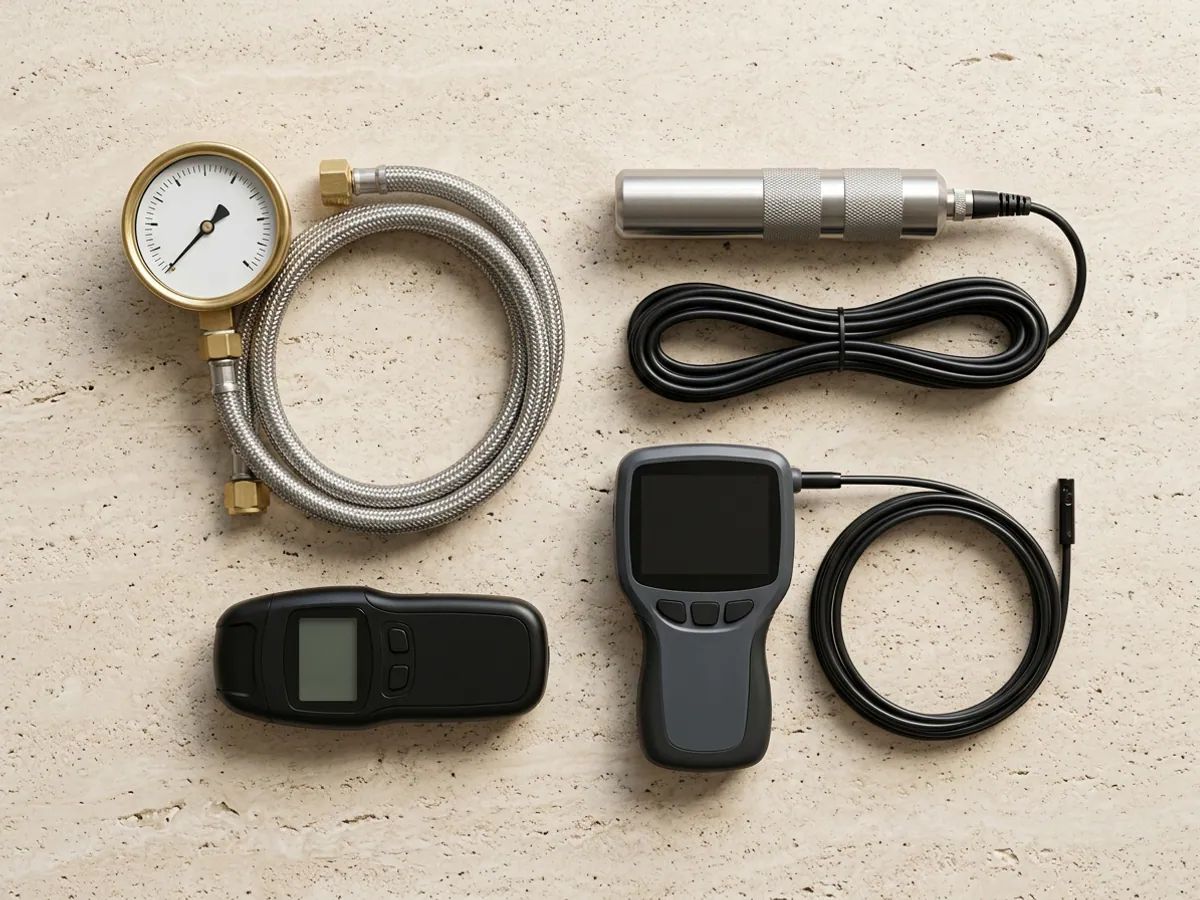
Traditional leak hunting often starts by breaking tiles or plaster right where a wet patch is visible—chasing damp sand or blockwork across a room until the leaking fitting is eventually uncovered. Because water migrates along slab slopes and sand beds, that trial-and-error approach frequently destroys intact flooring that had nothing to do with the pipe defect.
Non-destructive leak detection (frequently searched as electronic leak detection) replaces guesswork with systematic surface-level testing. By isolating pressurized pipe branches, listening for mechanical leak vibrations, observing surface thermal differentials, and mapping comparative moisture levels, technicians narrow down which system is failing and where the source is concentrated—without scratching a single tile during inspection.
True professionalism also requires transparency about what happens next: while the diagnostic inspection itself requires zero demolition, repairing a fractured pipe buried inside concrete or blockwork will later require opening a small, targeted access point directly over that verified spot.
In many Eastern Province villas and apartments, matching replacement tiles from earlier construction batches are no longer available. Breaking an entire bathroom floor or hallway strip leaves permanent visual mismatches and drives up restoration bills.
Equally important, field inspections regularly reveal that suspected "buried pipe bursts" are actually caused by accessible components—such as weeping recessed mixer cartridges, concealed toilet cistern flush valves, deteriorated shower perimeter silicone, or HVAC condensate—all of which can be serviced without breaking masonry or floor slabs.
When a buried PPR joint truly has failed, pinpointing its location first keeps subsequent repair access confined to one or two tiles. Learn more in under-tile water leak detection.
Non-invasive testing creates no dust, rubble, or noise disruption during the diagnostic visit, letting families plan any needed follow-up repair calmly.
No single instrument works identically across pressurized supply pipes, gravity drains, and tiled roofs. Accurate pinpointing combines four complementary physical checks:
Pressurized water escaping a narrow crack creates mechanical turbulence and sound vibrations transmitted along the pipe and surrounding mortar.
Closing branch shutoff valves one circuit at a time to verify whether cold supply, hot supply, or tank feed lines are losing pressure.
Identifies subtle temperature signatures on tiles or plaster caused by escaping hot water or evaporative cooling of damp areas (reading surface thermal anomalies per ASTM C1153 principles).
Compares near-surface dielectric moisture readings across dry and damp zones (per ASTM F2659) alongside isolated water pours into floor gullies and fixtures.
Engineering integrity note: Manar Al Sharqiya never claims sci-fi "laser X-ray vision through concrete." We apply established acoustic, thermal, hydraulic, and moisture physics interpreted systematically on site.
Evaluating the leak non-invasively first changes both cost exposure and disruption:
| Criteria | Traditional Exploratory Breaking | Non-Destructive Pre-Diagnosis |
|---|---|---|
| Starting Action | Chiseling tiles or plaster directly where dampness first appears. | Testing circuits, drains, and moisture gradients with zero surface damage. |
| Impact on Finishes | Multiple broken tiles, damaged waterproofing, and wide plaster patching. | Zero damage during inspection; minimal localized opening only if a buried pipe needs repair. |
| Misdiagnosis Risk | High when the real culprit is grout failure, a cistern valve, or condensation. | Low due to systematic elimination of accessible and non-pipe sources. |
| Restoration Cost | High tile, screed, waterproofing, and repainting expenses. | Minimized by targeting only the verified fault coordinate. |
Once non-destructive diagnostics identify the leak source, follow-up resolution falls into one of two practical categories:
Float valves, concealed toilet cistern mechanisms, under-sink angle valves, appliance hoses, shower silicone/grout joints, and accessible floor-trap seals can be repaired or resealed without breaking any tiles.
A split PPR fusion elbow beneath ceramic flooring or a punctured riser inside a block wall requires opening the specific pinpointed tile or plaster patch to weld a new fitting and pressure-test before closing.
Several building conditions determine how non-invasive tracing is conducted:
Tiles laid over older existing tiles or thick sand beds attenuate acoustic and thermal signals, requiring careful multi-point cross-checks.
Active booster pressure makes acoustic vibration and pressure-drop isolation clearer than gravity-fed low-pressure lines.
Back-to-back bathrooms or multi-floor risers require isolating each branch to confirm which circuit feeds the damp zone.
Call or WhatsApp Manar Al Sharqiya at 0590941982 with your property details for clear inspection scope guidance prior to booking.
Your tiles, marble, and painted walls remain intact throughout inspection.
We cross-verify pressure, moisture gradients, and fixture tests rather than guessing.
We tell you candidly whether a simple seal fix suffices or localized pipe access is needed.
Contact Manar Al Sharqiya at 0590941982 via phone or WhatsApp to confirm scheduling availability in your Eastern Province city or neighborhood.
In residential diagnostics they refer to the same approach: using non-invasive acoustic, thermal, comparative moisture, and hydraulic isolation checks to pinpoint concealed leaks without exploratory breaking.
Yes, though double-layered flooring dampens surface acoustic and thermal cues. Technicians rely more heavily on sequential valve pressure isolation and perimeter moisture gradient mapping to narrow down the faulty line.
Because gravity drains do not hiss under continuous pressure, they are tested by isolating supply lines first and then running controlled water volumes into individual fixtures and floor gullies while monitoring moisture response.
Yes. Keeping bathroom and kitchen floors dry for a few hours before inspection prevents surface wash water from masking underlying grout or sub-tile moisture readings.
When pipe routing is clear and the fault is pinpointed, repair access typically involves lifting only one or two tiles directly over the damaged joint rather than excavating the entire floor.
No. Non-destructive surface sensors and thermal imaging operate cleanly without puncturing, staining, or scratching painted walls, wallpaper, or stone surfaces.
Have another specific question about your property? Reach us directly by phone or WhatsApp.
Reach Manar Al Sharqiya by phone or WhatsApp at 0590941982 to describe your concealed leak symptoms and arrange an inspection.