Core Category Pillar — Technical Leak DiagnosticsEastern Province, Saudi Arabia
Water Leak Detection & Technical Diagnostics in the Eastern Province
Manar Al Sharqiya provides systematic water leak detection and moisture source diagnostics for residential villas, apartments, and commercial buildings in the Eastern Province—identifying the real fault across supply pipes, tanks, wet areas, and roofs before unnecessary breaking or repair work begins.
Transparent diagnostic guidance tailored to Saudi building construction—free of exaggerated promises or unverified claims.
Clear engineering separation between leak diagnosis, plumbing repair, and waterproofing
Methodical line-isolation and non-invasive tracing before recommending localized access
Direct bilingual inquiry via Phone or WhatsApp: 0590941982
Service Scope
Diagnostic Leak Pinpointing & Moisture Assessment
Property Types
Villas, Apartments & Commercial Facilities
Direct Contact
Call or WhatsApp 0590941982
1. Service Scope & Concealed Water Behavior
What Water Leak Detection Actually Covers
Water leak detection is a structured technical investigation designed to trace where water is escaping its intended containment—whether from a pressurized supply line, a gravity drainage joint, an underground storage tank, or a compromised wet-area seal. In Saudi residential and commercial construction, escaping water rarely surfaces directly over the pipe defect. Instead, it travels along sand-bedding layers beneath porcelain tiles, migrates through hollow concrete blocks and plaster interfaces, or follows structural slab slopes before emerging as a ceiling drip or blistering paint meters away.
Because surface stains can be deceptive, breaking tiles or chiseling plaster at the visible wet spot frequently misses the true origin and creates avoidable restoration costs. A proper diagnostic assessment evaluates the building’s hydraulic chain—from the post-meter courtyard line and underground concrete tank up through transfer pumps, rooftop storage tanks, booster sets, branch manifolds, and fixture connections.
At Manar Al Sharqiya, our focus during leak detection is diagnostic clarity: isolating which circuit or building element is losing water, distinguishing active plumbing failures from rain ingress or coastal condensation, and giving property owners an honest, actionable understanding of what needs attention next.
Separating the visible point of moisture emergence from the actual concealed leak source.
Differentiating continuous pressurized supply-line leaks from intermittent drain, grout, or rain-related seepage.
Providing clear, grounded findings so repair or waterproofing work targets the real root cause.
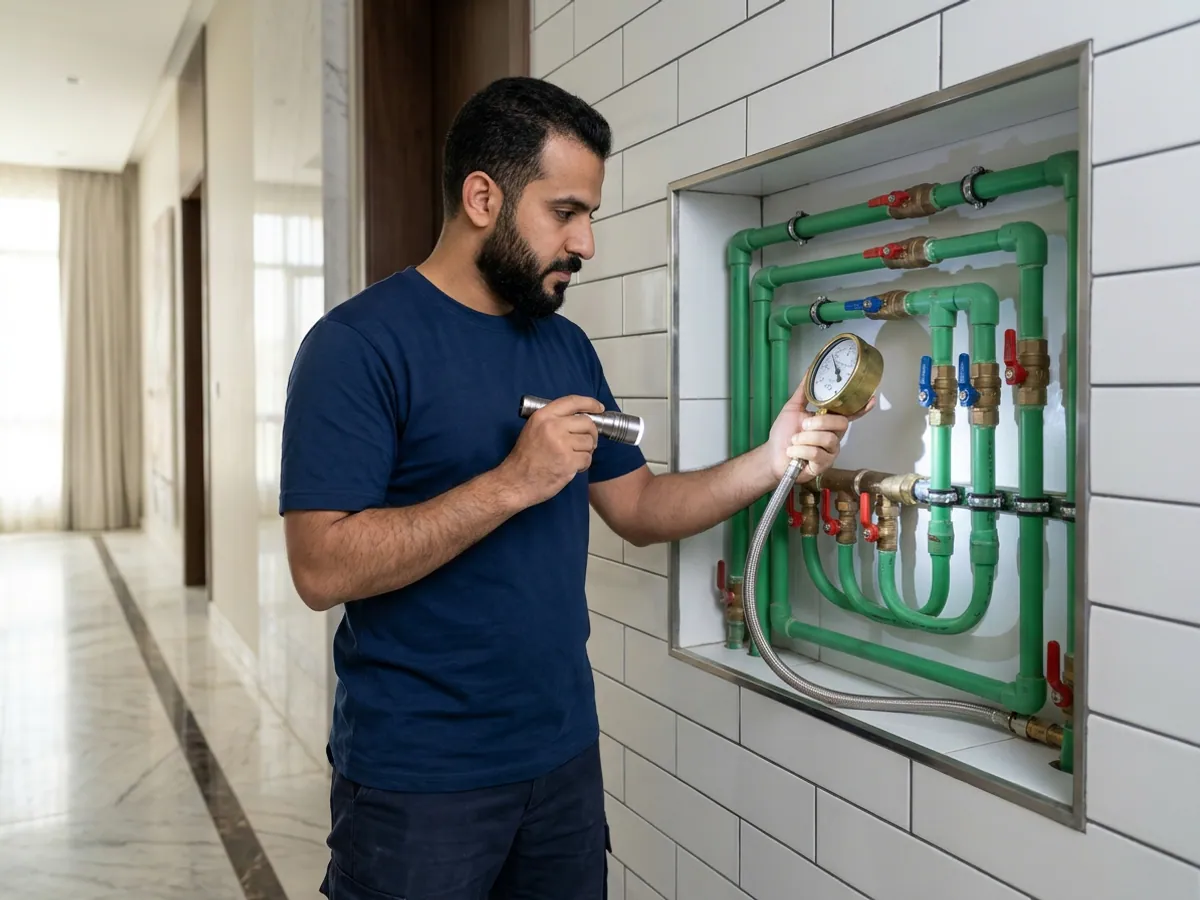
Systematic field evaluation of concealed plumbing circuits and moisture pathways inside a building.
2. Building Warning Indicators
Most Common Signs of a Concealed Building Leak
Hidden leaks often announce themselves through subtle hydraulic or surface clues long before open dripping appears. Recognizing these indicators early helps prevent slab saturation, rebar corrosion, and cabinet damage.
Blistering Paint, Peeling Putty & White Salt Efflorescence
Moderate Indicator
Paint bubbling or flaking along skirting boards and interior partitions accompanied by powdery white mineral deposits on cement plaster.
What it may indicate: Typically points to sustained moisture migration behind blockwork from an in-wall pipe leak or saturated floor bedding.
Discolored Rings or Active Dripping on Below-Slab Ceilings
High Diagnostic Priority
Yellowish-brown damp halos, sagging gypsum board, or water droplets forming beneath an upper-floor wet room or flat roof.
A sharp jump in metered water consumption despite unchanged household occupancy, irrigation habits, and daily routines.
What it may indicate: Frequently caused by silent underground tank, float-valve, or toilet-cistern waste requiring high water bill leak diagnostics.
Persistently Dark Grout Lines or Warm Spots on Tiled Floors
Moderate Indicator
Tile joints that remain dark and damp after drying, hollow-sounding ceramics, or a noticeably warm patch on ceramic or marble flooring.
What it may indicate: Localized floor warmth is a classic signature of a hot-water PPR pipe leak trapped in the sand screed—covered in under-tile leak detection.
Booster Pump Short-Cycling With All Taps Closed
High Diagnostic Priority
Hearing the rooftop pressure pump or ground transfer pump switch on every few minutes even when no fixtures are running.
What it may indicate: Indicates pressure decay inside a closed supply circuit due to a concealed pipe leak, check-valve bypass, or weeping cistern.
Musty Odors & Swollen Kitchen Base Cabinets or Door Frames
Early Sign
Warped MDF/wood cabinet plinths, damp odors under the sink, or swollen bathroom door jambs.
What it may indicate: Signals slow, concealed seepage behind fixed cabinetry—addressed through kitchen leak detection.
Rapid Ground-Tank Level Drop or Settling Courtyard Tiles
High Diagnostic Priority
Depleted underground storage despite normal supply, or sunken/loose interlocking pavers around the courtyard tank access cover.
What it may indicate: Points to outward water loss from the tank neck, float assembly, or concrete shell—requiring water tank leak detection.
Localized Pressure Drops Across Specific Floors or Zones
Early Sign
Noticeably weaker flow on one branch or floor manifold when aerators and filters are clean.
What it may indicate: May reflect line loss or distribution imbalance evaluated during a water network inspection.
Diagnostic note: A single symptom can stem from multiple causes—for instance, lower-wall dampness in coastal Eastern Province cities can arise from either a leaking pipe or capillary ground moisture. Reliable inspection cross-checks visual clues against meter and circuit behavior.
3. High-Risk Plumbing & Envelope Zones
Where Water Leaks Typically Originate in Saudi Properties
Villas and multi-unit buildings in the Eastern Province typically operate a dual-storage plumbing architecture—combining a buried concrete courtyard tank, transfer pump, rooftop storage tank, pressure booster pump, and concealed PPR/PVC branch piping. Each zone exhibits distinct failure modes:
1. Bathrooms & Wet Rooms
Bathrooms concentrate pressurized hot/cold lines, recessed shower mixers, concealed dual-flush cisterns, floor gullies, and tiled wet-area floors within a compact footprint. Explore bathroom water leak detection.
2. Kitchens & Behind Cabinetry
Heavy stone countertops and base cabinets conceal angle valves, RO water purifier tubing, dishwasher hoses, and grease-prone floor drains until sub-floor bedding saturates. See kitchen water leak detection.
3. Under Ceramic, Porcelain & Marble Flooring
Traditional mortar-over-sand bedding beneath Saudi villa floors acts like a sponge, allowing leaked pipe or grout water to travel laterally across rooms. Review under-tile water leak detection.
4. Inside Plastered Masonry Walls
Vertical risers, horizontal wall chases, and threaded brass mixer elbows buried behind cement plaster can weep silently, causing paint blistering and salt efflorescence. Read about in-wall leak detection.
5. Pressurized Supply & Buried Courtyard Pipes
Thermal expansion in hot-water PPR joints and soil settlement over exterior meter-to-tank pipes create hidden pressure losses. Learn more in pipe leak detection.
6. Underground & Overhead Water Tanks
Stuck mechanical float valves, unsealed tank necks, and structural cracks in buried concrete tanks account for massive invisible water loss. Visit water tank leak detection.
7. Flat Roofs, Scuppers & Rooftop Piping
Top-floor ceiling stains may originate either from seasonal rain ponding and parapet flashing defects or from continuous rooftop pump and heater unions. Explore roof leak detection.
Accurate leak detection follows an elimination sequence—moving from broad hydraulic verification down to localized pinpointing rather than relying on guesswork.
1
Symptom History & Usage Correlation
We review when dampness or high consumption began, whether staining intensifies after showers, appliance cycles, or rainfall, and whether any prior plumbing or painting repairs were attempted.
Step Purpose: Establishes whether the behavior matches a continuous pressurized leak, an intermittent drain fault, or envelope ingress.
2
Visual Inspection of Accessible Valves, Tanks & Fixtures
Checking the main water meter, ground-tank manhole neck and float valve, booster pump behavior, manifold shutoffs, concealed cistern plates, under-sink valves, and wet-area grout/sealant condition.
Step Purpose: Captures direct, accessible fixture or valve failures immediately without invasive work.
3
Surface Moisture Mapping & Gradient Reading
Comparing non-invasive surface moisture readings across affected and dry reference areas on walls, ceilings, and skirting lines to trace the direction of water migration.
Step Purpose: Identifies the highest concentration zone rather than mistaking the lowest gravity exit point for the source.
4
Circuit Isolation & Pressure / Level Verification
Sequentially closing zone valves across cold supply, hot return, and courtyard lines while monitoring pressure stability, pump cycling, or static tank water levels.
Step Purpose: Confirms definitively whether a pressurized supply circuit is losing water.
5
Non-Destructive Path Tracing Along the Compromised Line
Once loss is isolated to a specific pipe run, technicians trace the concealed path using complementary non-invasive methods suited to the substrate—such as acoustic vibration listening on pressurized lines and thermal anomaly observation along hot-water runs.
Step Purpose: Narrows the suspected fault zone to a localized spot prior to any repair access.
6
Differential Check: Supply vs. Drain vs. Waterproofing vs. Condensation
Controlled water testing of floor traps, shower pans, and drains alongside ambient dew-point and HVAC condensate checks.
Step Purpose: Prevents misdiagnosing failed tile grout or AC duct sweating as a broken supply pipe.
7
Clear Findings & Practical Next-Step Guidance
Explaining the verified leak mechanism, exact zone, and appropriate next action—whether targeted plumbing repair, float/grout maintenance, or subsequent waterproofing after drying.
Step Purpose: Gives the property owner complete clarity before authorizing any physical intervention.
Need a Clear Diagnostic Assessment for Your Property?
Call Manar Al Sharqiya directly or send a brief description on WhatsApp at 0590941982 to discuss your leak symptoms and schedule an inspection.
Non-Destructive Leak Detection — Practical Meaning & Limits
Many contractors advertise "leak detection without breaking" as if pipes inside concrete heal without touch. Engineering honesty requires distinguishing the diagnostic phase from the physical repair phase—explained in detail on our [non-destructive water leak detection](/en/services/non-destructive-leak-detection/) page.
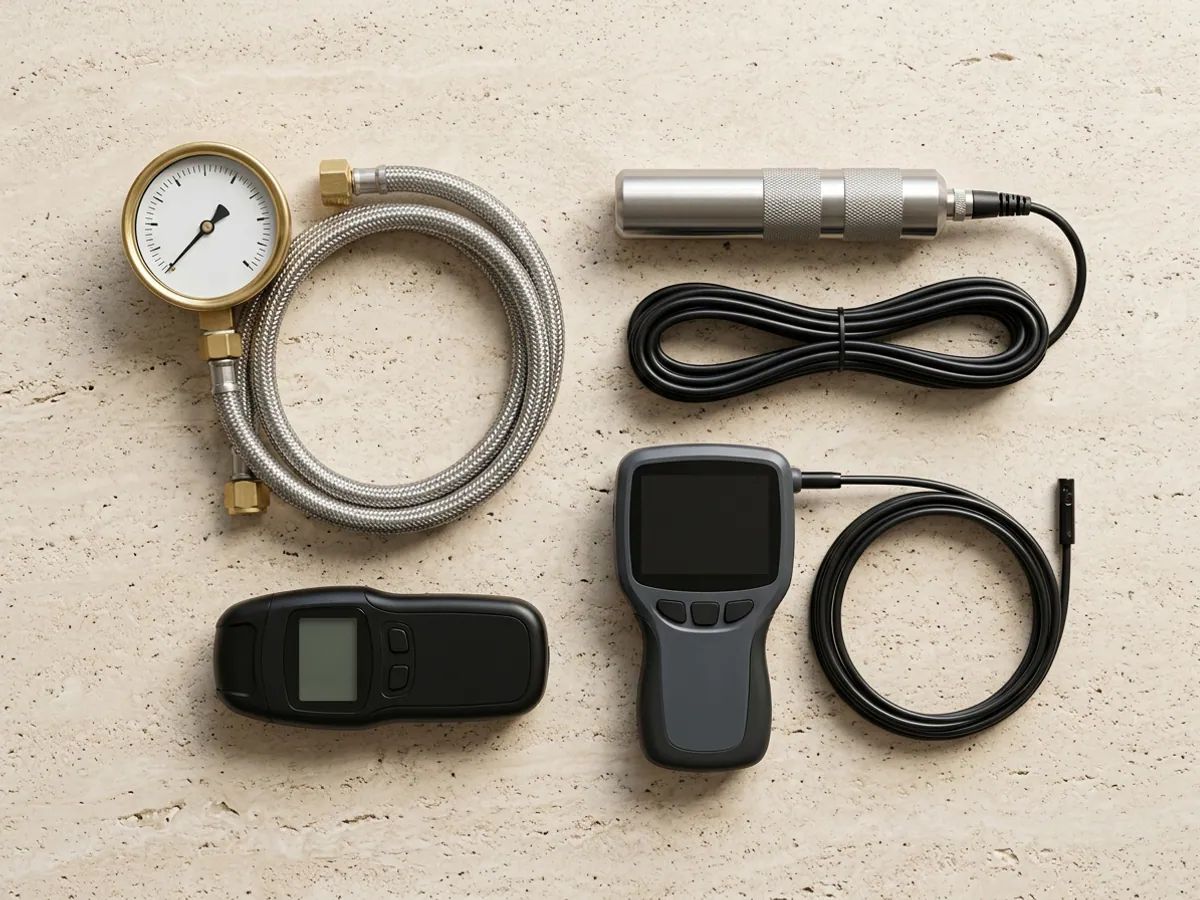
Zone Isolation & Hydraulic Pressure Monitoring
Segmenting cold, hot, and exterior pipe circuits via shutoff valves and observing pressure decay or meter movement under zero-draw conditions.
Best suited for: Confirming whether a concealed pressurized pipe leak exists and identifying which circuit carries it.
Practical limitation: Isolates the faulty branch but requires complementary surface tracing to pinpoint the exact coordinate.
Acoustic Leak Vibration Sensing
Water escaping a pressurized pipe orifice generates mechanical sound waves along the pipe wall and surrounding screed that peak near the breach.
Best suited for: Pressurized supply lines beneath tiled floors, courtyards, or plastered masonry in low-noise conditions.
Practical limitation: Less effective on unpressurized gravity drains, micro-seepage with negligible pressure, or deep loose sand fill.
Infrared Thermal Differential Observation
Detects surface temperature differences caused by escaping hot water or evaporative cooling of damp substrates (aligned with ASTM C1153 thermal anomaly principles—cameras read surface heat, not X-ray vision).
Best suited for: Tracing concealed hot-water pipes beneath ceramic tiles and mapping ceiling or roof moisture spread.
Practical limitation: Cannot see through dry concrete directly and can be influenced by solar heat gain or air conditioning.
Uses non-destructive electronic moisture readings (per ASTM F2659 comparative guidance) paired with isolated drain/trap water tests.
Best suited for: Separating shower grout, drain trap, and cistern seepage from pressurized supply failures.
Practical limitation: Measures near-surface moisture condition and must be interpreted alongside slab slope geometry.
Important Engineering Boundary:
The honest bottom line: Non-destructive leak detection means inspecting, tracing, and pinpointing the leak without random exploratory demolition. If the fault is an accessible float valve, cistern seal, or open tile grout, no breaking is needed at all. If a buried pipe inside a wall or slab is cracked, reaching it for repair will require opening only that small, pinpointed spot rather than tearing up an entire room.
Pinpointing the concealed fault zone non-invasively so finishes are protected from exploratory breaking.
6. Four Distinct Building Services
Leak Detection vs. Plumbing Repair vs. Waterproofing vs. Dampness Treatment
Confusing these four disciplines often leads homeowners to pay for roof waterproofing when a rooftop pipe union is leaking, or to repaint damp walls while a buried pipe continues weeping. Here is how each scope differs:
Comparison of Water Leak Detection, Plumbing Repair, Waterproofing, and Moisture Remediation
Service Discipline
Primary Objective
When It Is Needed
Relationship to Other Steps
1. Water Leak Detection (Diagnostics)
Pinpoint the exact moisture source and differentiate pipe, drain, tank, grout, and condensation issues.
Whenever stains, dripping, tank loss, or high water bills appear without an obvious visible break.
Always comes first so subsequent repair or waterproofing targets the verified cause.
Immediately after diagnostics confirm a mechanical pipe, valve, or fitting defect.
Stops active water escape; pressure stability should be verified before closing localized access.
3. Waterproofing (Roofs, Tanks & Wet Areas)
Apply engineered protective membranes or linings (cementitious, bituminous, polyurethane, epoxy).
During construction, or when inspection confirms aged membrane/grout failure on a roof, tank, or wet floor.
Protects structural concrete against standing/stored water, but never substitutes for fixing a broken pressurized pipe.
4. Moisture Remediation & Finish Restoration
Allow saturated masonry/screed to dry, remove salt-damaged plaster, improve ventilation, and repaint.
Only after the active water source or condensation trigger has been resolved.
Final cosmetic/hygienic stage; repainting over active dampness guarantees rapid blistering.
This cluster focuses specifically on technical water leak detection and moisture diagnostics. Protective waterproofing and thermal insulation are separate engineering scopes recommended only when inspection confirms substrate membrane needs.
7. Transparent Scope Drivers
Factors That Influence Leak Inspection Scope & Cost
Rather than publishing artificial bait prices that change on arrival, we evaluate the actual technical scope required for your building:
Property Type, Scale & Floor Count
Inspecting a single apartment bathroom involves a much narrower circuit than evaluating a multi-story detached villa with outbuildings, courtyard piping, and dual storage tanks.
Localized Symptom vs. Whole-Property Investigation
Tracing a stain below one known shower differs in time and testing steps from investigating an unexplained water bill spike across an entire property.
Valve & Access Panel Availability
Working zone shutoff valves, accessible cistern plates, and ceiling inspection hatches speed up circuit isolation compared to sealed legacy plumbing.
Flooring & Wall Finish Complexity
Thick stone slabs, deep courtyard concrete paving, or multi-layer wall cladding require more careful comparative tracing.
Interconnected Mechanical Systems
Central solar heaters with hot-water recirculation loops, irrigation branches, and multiple booster pumps increase the number of circuits tested.
Location Within the Eastern Province
Scheduling and scope details are confirmed transparently when you share your city and district by phone or WhatsApp.
Transparent communication: Contact Manar Al Sharqiya at 0590941982 by phone or WhatsApp to describe your issue and receive clear scope guidance before scheduling.
8. Safety & Specialist Escalation
When Immediate Shutoff or Specialist Escalation Is Required
Most household moisture symptoms allow time for scheduled diagnostics after isolating the local branch valve. However, certain scenarios pose immediate electrical or structural hazards that require prompt precautions:
Why Start With Clear Technical Diagnostics From Manar Al Sharqiya?
We prioritize accurate root-cause identification and finish preservation over exaggerated contractor claims.
Diagnosis Before Demolition
Know whether you are dealing with a simple valve/grout issue or a localized concealed pipe fault before authorizing breaking work.
Strict Discipline Separation
We clearly distinguish pressurized plumbing leaks from waterproofing membrane wear, drain seepage, and coastal condensation.
Frictionless Phone & WhatsApp Access
Reach us directly at 0590941982 to share photos or symptom notes and coordinate the appropriate inspection step.
Eastern Province Service Coverage
Water Leak Detection Inquiries Across the Eastern Province
Manar Al Sharqiya handles technical water leak detection inquiries for residential and commercial properties in the Eastern Province. Because dispatch scheduling depends on your specific city and district, call or WhatsApp 0590941982 to confirm availability for your location.
Frequently Asked Questions About Water Leak Detection
Direct engineering answers to common questions from homeowners, tenants, and property managers:
How can I tell if my villa has a hidden water leak before wall stains appear?
+
Key early warning signs include water meter dial movement when all taps and tank floats are shut, a booster pump cycling on briefly every few minutes without water use, faster-than-usual ground tank depletion, or an unexpected jump in your monthly bill. See our high water bill diagnostics page for initial checks.
Does water leak detection mean zero tiles will ever be removed?
+
The diagnostic inspection itself is non-destructive—we do not break floors or walls randomly to search for a leak. Afterward, if the fault is an accessible float valve, cistern mechanism, or open tile grout, no tile removal is needed. If a buried pipe beneath tiles is fractured, repairing that pipe requires opening only the small pinpointed area.
Why does water drip from a ceiling spot far from any bathroom fixtures?
+
Water escaping beneath tiles saturates the sand screed or travels along hollow-core concrete slab channels and sloped screeds until it reaches a construction joint, light conduit, or lower point where gravity lets it drip through.
Can applying waterproofing over tiles stop an active pipe leak underneath?
+
No. Coating over an active pressurized pipe leak traps escaping water beneath the slab, forcing moisture outward into adjacent bedroom walls, door frames, and ceilings below. Pressurized pipes must always be checked and repaired before waterproofing.
How long does an on-site water leak inspection typically take?
+
Inspection duration depends on the scope: checking a single bathroom ceiling leak is much faster than isolating circuits across a large villa with ground tanks, courtyard lines, rooftop pumps, and multiple wet zones. We clarify expected scope when you contact us.
What immediate step should I take if water starts dripping from a ceiling?
+
First, switch off the electrical breaker for ceiling lights in that room if water is near fixtures. Next, close the isolation valve feeding the bathroom or plumbing zone above, and avoid scraping or repainting damp plaster before the true leak source is verified.
Can you inspect leaks between an upper apartment and a lower apartment?
+
Yes. Multi-unit ceiling leaks usually require observing the stain pattern in the lower apartment and coordinating access to test supply valves, drains, and tile joints in the corresponding wet room directly above.
What details should I share when contacting Manar Al Sharqiya?
+
Let us know your city/district in the Eastern Province, building type (villa or apartment), where the dampness or water loss appears, whether it happens continuously or only after fixture use or rain, and whether your water bill has increased.
Have another specific question about your property? Reach us directly by phone or WhatsApp.
Differential diagnosis for bathroom water leaks in the Eastern Province: separate pressurized pipe faults, drain traps, cistern seepage, and tile joint failure. Call 0590941982.
Diagnose water loss, float valve failure, neck-joint seepage, and groundwater infiltration in underground and rooftop tanks in the Eastern Province. Call 0590941982.
Identify whether top-floor ceiling leaks come from rain ponding, blocked scuppers, parapet joints, or rooftop water lines in the Eastern Province. Call 0590941982.
Locate hidden kitchen water leaks behind cabinetry, RO water filters, dishwashers, floor traps, and concealed wall lines in the Eastern Province. Call 0590941982.
Zone-by-zone water distribution network inspection across tanks, booster pumps, rooftop manifolds, and risers for villas and buildings. Call 0590941982.
Facing an unexpected water bill spike in the Eastern Province? Inspect post-meter pipes, ground tank float valves, and silent cistern leaks. Call 0590941982.
Identify the true cause of wall dampness, salt efflorescence, and peeling paint in the Eastern Province: plumbing leak vs rain ingress vs condensation vs rising damp. Call 0590941982.
Technical waterproofing services across the Eastern Province, Saudi Arabia for roofs, water tanks, and wet areas. Substrate-matched membrane systems. Call 0590941982.
Learn how to spot early concealed water leak clues—warm floor tiles, dark grout lines, swollen skirting boards, and ceiling rings—before structural damage spreads.
Transparent engineering guide to the technical variables driving leak detection, roof waterproofing, and tank lining costs—and how to compare contractor quotes.