Building Envelope Thermal Performance · Eastern Province Eastern Province — Roof & Envelope Thermal Systems

Thermal Insulation in the Eastern Province

Uninsulated concrete roofs in the Eastern Province absorb intense solar energy throughout summer days and radiate stored heat downward into upper-floor rooms well into the night. Manar Al Sharqiya helps property owners evaluate and install roof thermal insulation assemblies engineered around real thermal resistance (R-value), layer continuity, and proper integration with waterproofing.

Engineering rule: Rigid thermal boards do not stop rainwater at board joints—they must always operate alongside a continuous waterproof membrane.

Grounded in real thermal resistance (R-value), conductivity (lambda), and SBC 601/602 principles
Clear distinction between bulk thermal insulation and thin solar-reflective paints
Zero exaggerated or unverified electricity-bill reduction percentage claims
Physical Mechanism
Retards conductive & radiant heat flow across roofs
Code Context in KSA
Saudi Building Code energy principles (SBC 601 / 602)
Primary Roof Options
Inverted XPS Boards · UV-Protected Closed-Cell SPF
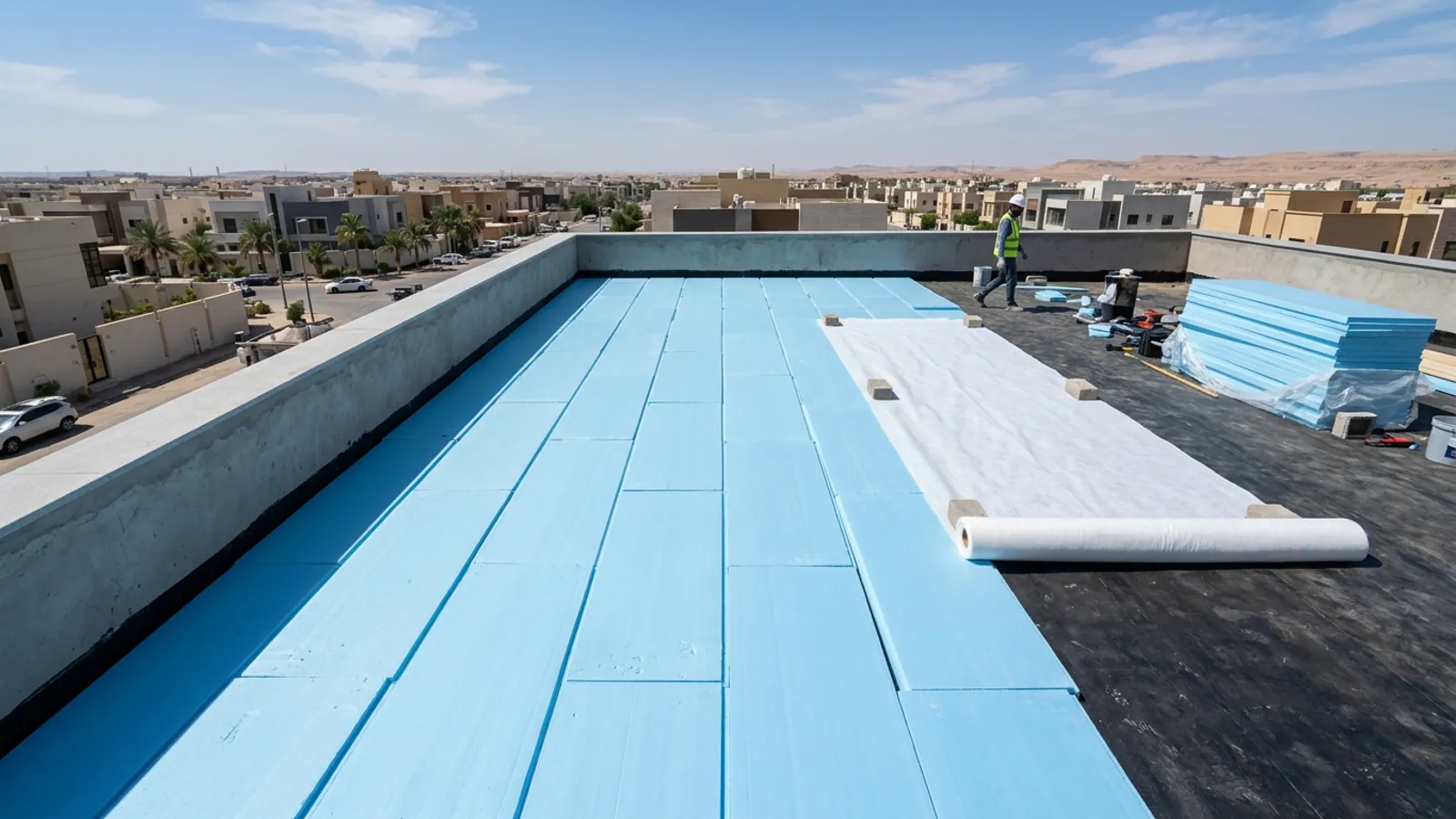
Technicians installing rigid roof thermal insulation boards over a protected waterproofing layer
Building Heat-Transfer Physics

What Thermal Insulation Means & How It Slows Heat Flow

Heat naturally flows from warmer outdoor surfaces toward cooler air-conditioned interiors via conduction through solid concrete, convection via air leakage, and solar radiation. Bare reinforced concrete has relatively high thermal conductivity and high thermal mass: it heats up rapidly under direct Gulf sun and continues releasing stored heat into top-floor ceilings hours after sunset.

Thermal insulation introduces a continuous low-conductivity layer filled with microscopic closed gas cells or trapped air pockets. By increasing envelope thermal resistance, it slows conductive heat gain through the roof slab, stabilizes indoor ceiling temperatures, and reduces thermal cycling stress on the structural deck.

  • Targets the horizontal roof plane—the building surface receiving the highest summer solar load.
  • Improves thermal comfort in top-floor bedrooms, living spaces, and rooftop annexes.
  • Shields structural concrete slabs and underlying waterproof membranes from extreme thermal shock.
  • Aligns with Saudi Building Code thermal envelope concepts (SBC 601 commercial and SBC 602 low-rise residential).
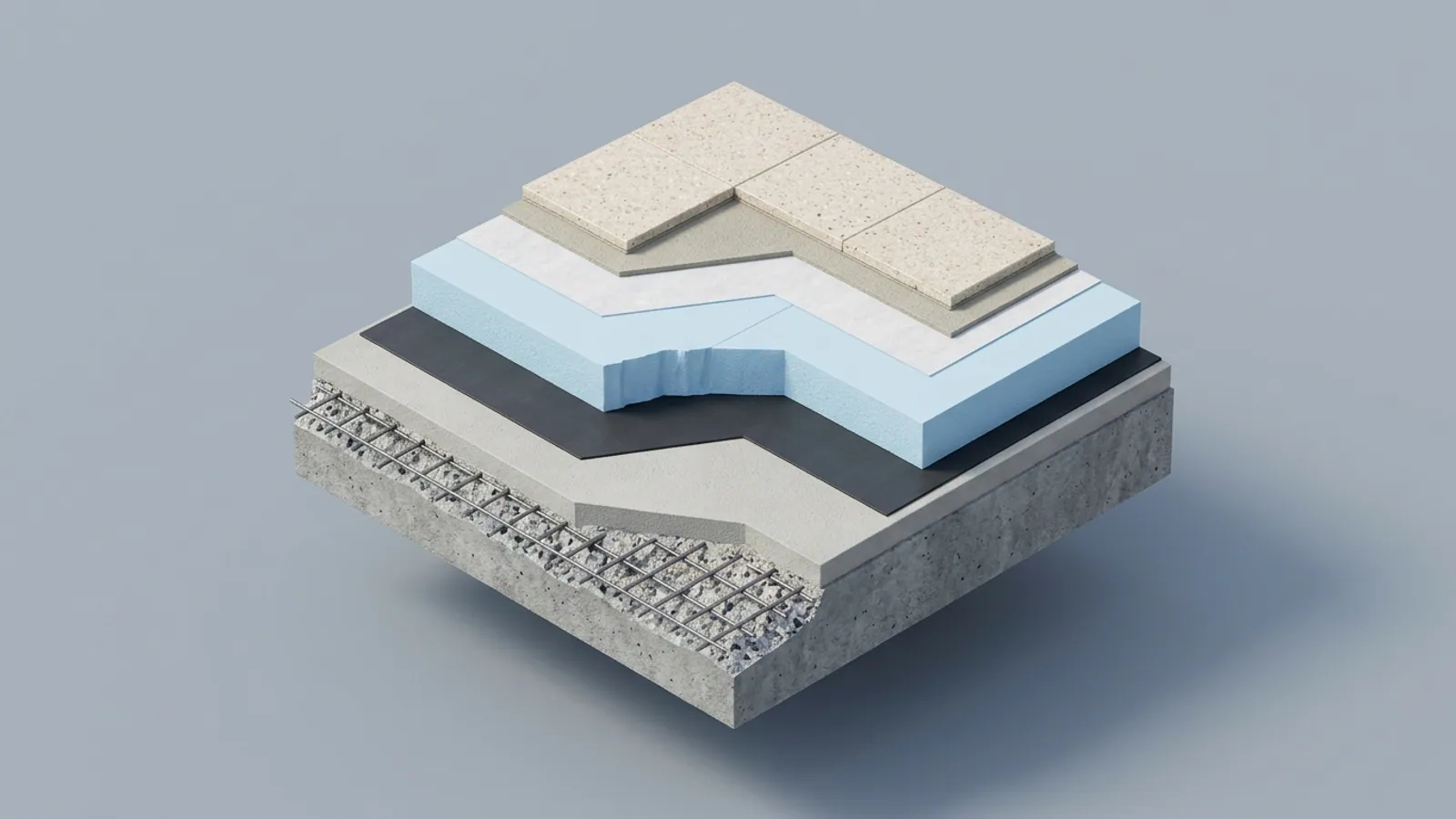
Educational Technical Illustration
Conceptual architectural cross-section showing structural slab, sloped screed, waterproofing, thermal insulation, and protection layers
Conceptual roof cutaway showing structural slab, sloped screed, waterproof membrane, rigid thermal insulation, filter fleece, and upper protection.
Core Thermal Metrics Explained Simply

Understanding Thermal Resistance (R-Value), Conductivity & Assembly U-Value

Evaluating thermal materials objectively relies on three measurable engineering properties rather than marketing slogans:

1. Thermal Conductivity (Lambda — λ)

Measures how readily a material conducts heat in W/(m·K). Lower lambda values indicate slower heat conduction for a given thickness.

2. Thermal Resistance (R-Value)

Calculated as installed thickness divided by thermal conductivity (R = d / λ). A material only delivers meaningful R-value when installed at adequate, uniform thickness—ultra-thin coats cannot substitute for bulk thickness.

3. Overall Assembly Transmittance (U-Value)

Represents the total heat transfer rate across the complete roof or wall buildup. Lower U-values signify superior envelope insulation under SBC Climate Zone 1 targets.

4. Where Thermal Insulation Is Applied

Exposed flat concrete and corrugated metal roofs represent our primary retrofit and new-build focus (integrated closely with roof waterproofing), alongside insulated masonry/cavity walls constructed during civil works.

Thermal Material Specifications

Categories of Thermal Insulation Materials

Rooftop thermal systems primarily utilize closed-cell rigid boards or closed-cell spray foam paired with UV-protective topcoats:

Thermal System (Non-Containment)

Extruded Polystyrene Rigid Thermal Boards (XPS)

Dedicated thermal insulation layer reducing conductive heat transfer across roofs and walls (raising assembly R-value)

Typical Applications

  • Inverted/protected membrane roofs installed above the waterproofing membrane and beneath filter fabric + tiles/ballast
  • Upgrading roof assembly thermal resistance aligned with Saudi Building Code energy principles (SBC 601 / SBC 602)

Technical Properties

  • Closed-cell rigid foam core offering low thermal conductivity and high compressive strength under roof tiles or gravel ballast
  • Shiplap/rabbeted board edges minimize linear thermal bridging when laid in staggered courses

Engineering Limitations

  • Rigid thermal boards are NOT waterproofing! Rainwater flows freely between board joints and requires a continuous waterproofing membrane underneath
  • Degrades under direct UV light and petroleum solvents, and can float during heavy rain unless ballasted/tiled over geotextile fleece
Substrate Preparation: Laid flat over a completed, flood-tested waterproofing membrane on an even plane without point-load protrusions.
Layer Compatibility: Must be covered with a non-woven geotextile filter fabric before laying sand/mortar beds or gravel ballast so fines do not foul joints.
Safety Controls: Combustible polymeric foam; must be isolated beneath non-combustible ballast/pavers/screed and kept strictly away from open flames.
Potable-Water Note: Building-envelope thermal board; never used inside water tanks.

Relevant Technical References: ASTM C578 · SBC 601 · SBC 602

Not Suitable for Potable Water Contact

Closed-Cell Spray Polyurethane Foam Roofing System (SPF)

Seamless composite thermal-and-moisture roofing assembly ONLY when completed with a protective UV elastomeric coating

Typical Applications

  • Concrete flat roofs and profiled metal roofs requiring seamless encapsulation over fasteners, curbs, and parapets
  • Roofs needing lightweight continuous thermal resistance and parapet thermal-bridge coverage in one assembly

Technical Properties

  • Roofing-grade medium/high-density closed-cell SPF (per ASTM C1029) delivers continuous thermal resistance and self-flashing adhesion
  • Low-density open-cell foam is strictly an interior dry acoustic/thermal fill and is NOT water-resistant

Engineering Limitations

  • Bare SPF is NEVER a finished roof! Uncoated foam rapidly photo-oxidizes, yellows, and chalks under Saudi UV exposure without an elastomeric protective topcoat
  • Susceptible to mechanical puncture from dropped tools, foot traffic around AC units, and bird pecking unless protected or fitted with walk pads
  • Standing ponding water degrades standard acrylic topcoats if positive roof drainage slopes are absent
Substrate Preparation: Completely dry, dust-free, oil-free substrate sprayed within strict ambient wind, humidity, and deck-temperature limits to prevent pinholes or delamination.
Layer Compatibility: Protective UV elastomeric topcoat must be applied promptly over clean, freshly cured SPF before UV oxidation fouls inter-coat adhesion.
Safety Controls: Combustible organic plastic requiring an approved 15-minute thermal/ignition barrier in interior spaces (per IBC Ch. 26 / SBC 201 fire code rules) and full respiratory PPE during spray application.
Potable-Water Note: Strictly unsuitable for internal potable water tank lining.

Relevant Technical References: ASTM C1029 · ASTM D6083 · IBC Chapter 26 · SBC 201 · SBC 601 / 602

Not Suitable for Potable Water Contact

UV-Reflective Elastomeric Protective Topcoats

Shielding underlying SPF or compatible membranes from UV degradation, weathering, and solar heat absorption

Typical Applications

  • Mandatory weatherproofing and UV shield applied over exterior closed-cell spray polyurethane foam roofs
  • Periodic maintenance recoating over sound, compatible elastomeric roof assemblies after adhesion testing

Technical Properties

  • Blocks destructive UV radiation and lowers peak roof-skin temperature via high solar reflectance when kept clean
  • Available in acrylic, aliphatic polyurethane, and silicone chemistries with differing ponding-water and dirt-pickup resistance

Engineering Limitations

  • Thin reflective paint is NOT bulk thermal insulation (negligible R-value), and dust accumulation in desert climates reduces reflectance over time
  • Acts as a sacrificial wearing layer requiring periodic inspection and maintenance recoating before underlying foam is exposed
Substrate Preparation: Clean, dry, unoxidized foam/membrane surface applied in controlled multi-coat dry-film thickness.
Layer Compatibility: Acrylic and polyurethane coatings will not adhere over existing silicone coatings without specialized compatible primers/topcoats.
Safety Controls: Wet or smooth elastomeric roof coatings can be slippery; use safe rooftop footing and perimeter awareness.
Potable-Water Note: Exterior roof coating only; not for potable water contact.

Relevant Technical References: ASTM D6083 · ASTM D6694 · SBC 601 / 602 (SRI notes)

Fibrous mineral wool and fiberglass batts are used in dry cavity walls and industrial dry roofs, provided vapour/water barriers prevent moisture wetting that would degrade their R-value.

Real-World Envelope Variables

Eight Real-World Factors Governing Thermal Performance

We never promise fixed percentage cuts on electricity bills because real building cooling demand depends on eight interacting variables:

01

1. Installed Insulation Thickness

Thermal resistance scales directly with thickness; undersized layers yield proportionally smaller heat-transfer reductions.

Physical Mechanism: Selected based on roof parapet height, door thresholds, and target R-value.

02

2. Board Continuity & Staggered Joint Fit

Open gaps between rigid boards let hot air and rainwater bypass the thermal layer.

Physical Mechanism: Shiplap or tongue-and-groove edges must be laid tightly without voids.

03

3. Structural Thermal Bridges

Uninsulated concrete parapets, columns, and slab edges conduct heat around insulated zones.

Physical Mechanism: Continuous over-deck coverage minimizes slab-edge bridging.

04

4. Keeping the Insulation Dry

Water conducts heat over twenty times faster than trapped air; water-logged insulation loses its thermal value.

Physical Mechanism: Requires closed-cell chemistry on roofs and reliable waterproofing.

05

5. Window Glazing Area & Solar Orientation

Unshaded west- and south-facing glass admits substantial solar heat independent of roof R-value.

Physical Mechanism: Roof insulation addresses roof load specifically, not window solar gain.

06

6. Air Tightness & Coastal Humidity Infiltration

Humid coastal air leaking through unsealed shafts and frames adds heavy latent dehumidification load to AC units.

Physical Mechanism: Cold thermal bridges in humid rooms can also trigger condensation—see moisture & dampness diagnostics.

07

7. Surface Solar Reflectance & Dust Soiling

Light-colored tiles or clean white elastomeric coats reduce surface temperature compared to dark membranes.

Physical Mechanism: Airborne dust lowers surface reflectance over time while bulk R-value underneath remains active.

08

8. HVAC System Efficiency & Thermostat Setpoints

Duct leakage, AC SEER ratings, and occupancy schedules heavily influence monthly kWh totals.

Physical Mechanism: Explains why ethical engineering avoids one-size-fits-all bill-saving guarantees.

Roof Layering & System Clarity

Roof Thermal Assemblies: Bulk Insulation vs. Waterproofing vs. Reflective Paint

In modern inverted roof design, the waterproof membrane sits directly on the sloped concrete deck, shielded above by a geotextile separator, XPS thermal boards, filter fabric, and tiles/gravel. Compare the three distinct layer types below:

Engineering distinction between bulk thermal insulation, waterproof membranes, and thin reflective coatings
Performance AttributeBulk Thermal Insulation (XPS / Closed-Cell SPF)Waterproof Membranes (Bitumen / Cementitious)Thin Reflective White Paint Alone
Conductive R-Value High, calculable thermal resistance proportional to thickness Negligible thermal resistance Near-zero conductive R-value; acts only via surface solar reflectance when clean
Rainwater Barrier Capability XPS boards pass water through joints; closed-cell SPF blocks water when UV-coated Primary continuous barrier against liquid water Minor weather shedding only; never a substitute for engineered waterproofing
Sensitivity to Dust Accumulation Unaffected—bulk R-value works beneath the surface finish Watertightness unaffected by dust Loses significant solar reflectivity once coated with desert dust

Read our full breakdown in waterproofing vs. thermal insulation.

Avoiding Specification Pitfalls

Common Thermal Insulation Mistakes to Avoid

Common Execution Mistake

Treating 1 mm Reflective Paint as Equivalent to 50+ mm Thermal Insulation

Thin reflective coatings cannot stop evening conductive heat transfer or satisfy SBC envelope U-value targets on their own.

Sound Engineering Practice: Use elastomeric reflective coatings as protective UV topcoats over closed-cell foam or membranes, not as standalone thermal replacements.

Mandatory Safety Boundary

Leaving Spray Foam Uncoated Outdoors or Exposed Indoors Without a Thermal Barrier

Uncoated exterior SPF degrades rapidly in UV light, while interior exposed foam violates building fire-safety thermal barrier rules (SBC 201 / IBC Ch. 26).

Sound Engineering Practice: Apply UV elastomeric topcoats outdoors promptly and enforce fire-rated thermal barriers over any interior foam.

Material Engineering Limit

Laying Polystyrene Boards Over Wet Solvent-Based Bitumen

Organic solvents chemically attack and dissolve polystyrene cells on contact.

Sound Engineering Practice: Allow waterproofing primers/membranes to cure fully and install a non-woven geotextile separation fleece.

Common Execution Mistake

Installing Loose Boards With Wide Gaps & Inadequate Ballast

Wind uplift displaces unballasted boards while gaps create severe thermal bridging.

Sound Engineering Practice: Interlock shiplap edges tightly and cover with filter fabric plus concrete tiles or washed gravel ballast.

Scope & Cost Drivers

Factors Influencing Scope & Cost

Roof thermal insulation cost depends on four practical project parameters:

Material Type, Density & Specified Thickness

Board thickness (e.g. 50 mm vs 80+ mm XPS) or closed-cell SPF lift thickness directly governs material volume.

Underlying Waterproofing Condition

Whether a sound waterproof membrane already exists or must be installed beneath the thermal layer.

Upper Protection & Ballast Finish

Choice between interlocking roof tiles, gravel ballast over geotextile, or elastomeric UV topcoats.

Roof Geometry, Parapet Thresholds & MEP Curbs

Fitting insulation cleanly around AC pedestals, skylights, and doorway step heights.

Share your roof details with us via WhatsApp or phone for transparent guidance tailored to your building.

Scope Clarity & Transparency

Physics-Driven Thermal Consultation With Manar Al Sharqiya

Honest Building-Science Explanations

We explain R-value, thickness, and thermal bridging clearly without fabricated electricity-saving promises.

Integrated Waterproofing + Thermal Layering

Ensures chemical compatibility and proper moisture protection so thermal layers stay dry and effective.

Suited for Eastern Province Summers

Focuses on high-density closed-cell systems built to endure Gulf rooftop heat and coastal humidity.

Eastern Province Service Coverage

Thermal Insulation Inquiries Across the Eastern Province

Planning thermal insulation for a new build or looking to reduce upper-floor heat gain in an existing Eastern Province property? Call or WhatsApp 0590941982 to discuss suitable roof assemblies.

Technical FAQ

Frequently Asked Questions About Thermal Insulation

What exact percentage will roof thermal insulation cut from my electricity bill?

No responsible engineer can guarantee a fixed bill-reduction percentage without modeling the entire building—glazing area, wall insulation, air infiltration, AC efficiency, and thermostat habits all affect total consumption. Properly specified roof insulation reliably lowers conductive roof heat gain and eases top-floor cooling load.

Should waterproofing go below or above rigid thermal insulation boards on a flat roof?

In an inverted protected-membrane roof (PMR), the waterproof membrane is installed directly on the sloped concrete deck first, followed by a geotextile separator and water-resistant XPS thermal boards above—shielding the membrane from UV and extreme temperature swings.

Does white reflective roof paint replace rigid thermal boards or spray foam?

No. Thin reflective coatings reduce daytime surface absorption when clean, but provide virtually zero conductive R-value and lose reflectivity as dust settles. They work best as a protective UV topcoat over bulk insulation.

Do extruded polystyrene (XPS) thermal boards make a roof waterproof on their own?

No. Although closed-cell XPS resists absorbing water into the board core, rainwater flows freely between board joints down to the slab unless a continuous waterproof membrane lies beneath.

When is closed-cell spray polyurethane foam a suitable thermal option?

Closed-cell SPF works well on corrugated metal roofs and exposed concrete decks with complex equipment curbs because it forms a seamless monolithic thermal + waterproof blanket—provided it receives a mandatory UV elastomeric topcoat. See spray polyurethane foam insulation.

Can thermal insulation help prevent interior ceiling condensation?

Yes. By keeping interior concrete soffit temperatures warmer and eliminating cold/hot thermal bridges where humid indoor air reaches dew point, continuous insulation helps reduce surface condensation.

Can thermal insulation be added to an occupied villa with an existing tiled roof?

Depending on door threshold clearance, parapet height, and whether the existing roof waterproofing is dry and sound, inverted board overlays or UV-coated foam systems can be evaluated upon inspection.

How do I inquire about thermal insulation options with Manar Al Sharqiya?

Call or WhatsApp 0590941982 with your property type, current roof finish (bare concrete, tiled, or corrugated metal), and location in the Eastern Province.

Have another specific question about your property? Reach us directly by phone or WhatsApp.

City-Specific Coverage

Confirmed Eastern Province Cities for This Service

Scheduled on-site visits are arranged by appointment across the following confirmed cities:

Thermal Envelope Consultation · Manar Al Sharqiya

Explore Suitable Thermal Insulation Options for Your Property

Contact us on WhatsApp or by phone to describe your roof deck and location in the Eastern Province and review compatible thermal systems.

Helpful Details to Mention When Contacting Us:

  • Your city/district in the Eastern Province and property type (villa, apartment, commercial).
  • Visible symptoms (wall dampness, ceiling drip, tank drop, or sudden water bill spike).
  • Whether the symptom is continuous or appears only after fixture use or rainfall.

Or Prepare Your Inspection Details Below

Direct server submission is pending activation; you can send these exact details immediately via WhatsApp or call us directly.

Call Now 0590941982

We respect your privacy and never share personal details with third-party marketers. Read our Privacy Policy.