Comparing Roof Waterproofing & Insulation Materials in Saudi Arabia: Bitumen, Spray Foam, Liquid Membranes & Cementitious
No single waterproofing chemistry is universally "best" for every roof in Saudi Arabia. The ideal assembly for a newly cast concrete villa deck destined for porcelain pavers differs fundamentally from a corrugated metal warehouse roof or an MEP-congested service deck. This engineering guide compares the four primary material families objectively across Gulf climate realities.
Key Engineering Takeaways
- APP/SBS modified-bitumen sheet membranes deliver guaranteed factory thickness beneath tiled or inverted XPS roof assemblies.
- Closed-cell spray polyurethane foam (SPF) + UV elastomeric coating provides lightweight seamless thermal-and-waterproof protection on metal (Shinko) and obstacle-dense roofs.
- Liquid-applied polyurethane membranes create joint-free flashing around dense rooftop penetrations provided positive drainage slopes prevent ponding.
- 2K polymer-modified cementitious slurries excel beneath tile in bathrooms, small balconies, and water tanks—not across wide sun-exposed roofs.
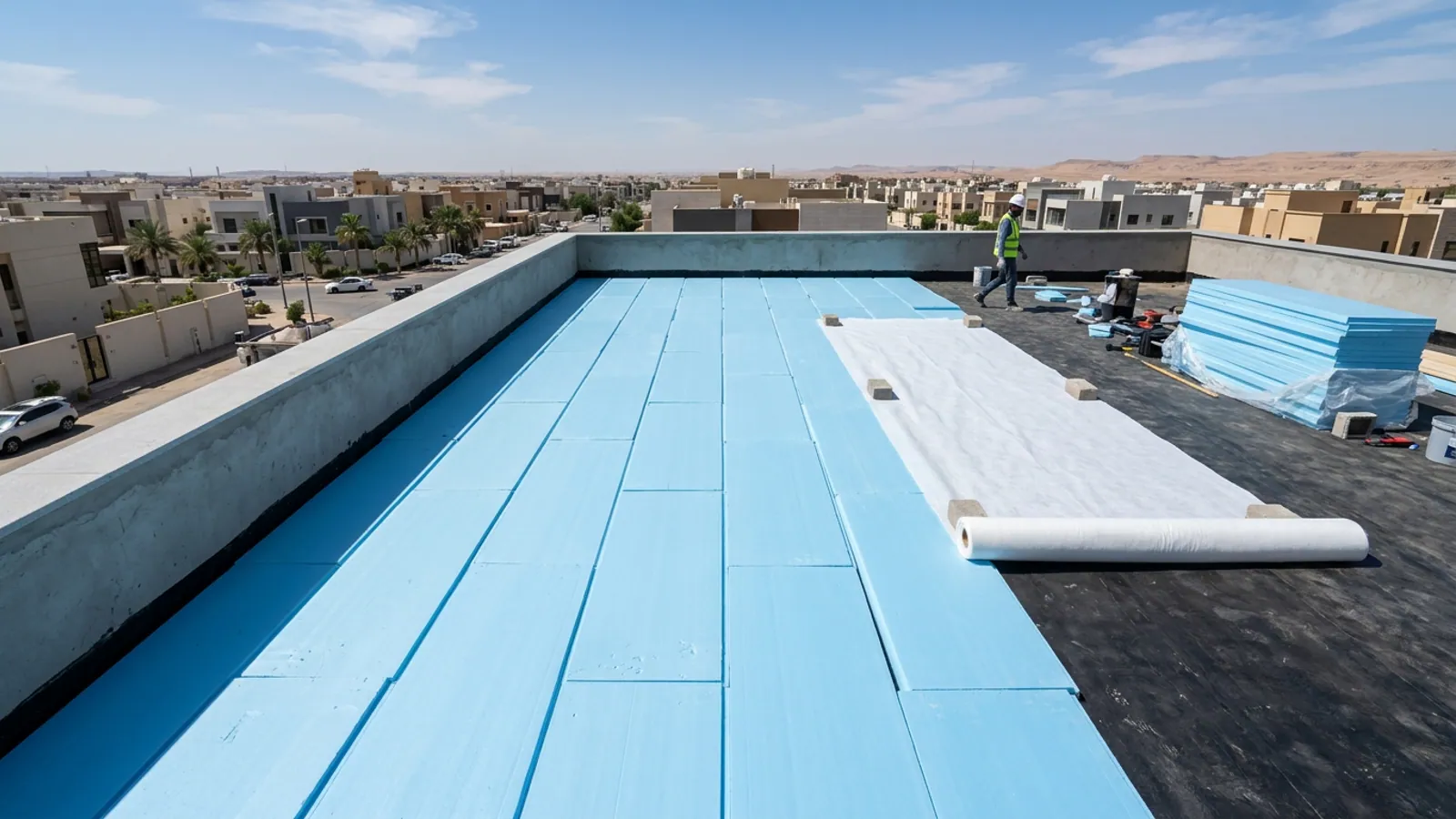
How Engineers Match Roof Materials to Eastern Province Buildings
Before comparing brand names, a proper roof waterproofing specification evaluates five site variables: structural deck type (bare reinforced concrete, existing tile over sand bed, or profiled metal sheeting), intended foot traffic, density of AC plinths and pipe penetrations, drainage slope efficiency toward scuppers/drains, and whether bulk thermal resistance is needed simultaneously.
Most costly roof failures occur when a valid product is applied to an incompatible substrate—such as brushing rigid cementitious slurry across a sun-baked roof slab or rolling standard acrylic paint across flat ponding depressions.
- Deck substrate and final wearing finish dictate membrane chemistry first.
- Factory-gauged roll thickness vs. seamless liquid/spray monolithic detailing.
- Direct Saudi UV weatherability vs. buried protected-membrane assemblies.
Modified Bitumen Rolls vs. Closed-Cell SPF vs. Liquid Elastomeric vs. 2K Cementitious
| Evaluation Criterion | APP/SBS Bitumen Rolls | Closed-Cell SPF + UV Coat | Liquid PU / Elastomeric | 2K Flexible Cementitious |
|---|---|---|---|---|
| Seam Architecture | Overlapped rolls relying on fused 10–15 cm side/end seams | 100% seamless monolithic blanket over curbs & parapets | Seamless cured membrane eliminating lap joints | Brush/trowel seamless coat for confined sub-tile zones |
| Thickness Control | Uniform factory-manufactured gauge (typically 4 mm) | Installer-dependent spray pass thickness & core density | Strictly dependent on monitored wet-film coverage per m² | Thin two-coat perpendicular slurry (~2 mm total) |
| Built-In Thermal R-Value | None—pair with XPS thermal boards above for heat control | High—combines thermal R-value and moisture barrier | Solar reflectance (white) only; negligible conductive R-value | None—strictly a sub-tile moisture barrier |
| Ideal Roof Scenario | New flat concrete roofs beneath tiles or inverted XPS systems | Corrugated metal (Shinko) roofs & MEP-crowded exposed decks | Detail-heavy exposed concrete roofs with positive drainage | Small tiled balconies, wet rooms, and sump details |
| Primary Vulnerability | Poor seam welding at tight corners or crowded pipe clusters | Rapid UV chalking if topcoat is neglected; point-load punctures | Standard acrylics soften under >48h ponding; slab vapor blisters | Insufficient elongation for wide thermal expansion on large roofs |
Bituminous Waterproofing vs. Polymer-Modified Cementitious Waterproofing
Understanding why bitumen dominates protected flat roofs while cementitious systems dominate wet areas and tanks prevents major specification errors:
| Technical Parameter | Bituminous Systems (Rolls & Emulsions) | 2K Polymer-Modified Cementitious |
|---|---|---|
| Concrete Moisture State at Application | Requires surface-dry concrete prior to primer to prevent vapor blisters | Applied onto pre-dampened saturated surface-dry (SSD) concrete |
| Direct Tile Adhesive Compatibility | Incompatible—cementitious tile mortars cannot bond to smooth bitumen | Excellent—accepts polymer-modified tile adhesives directly once cured |
| Wide-Span Thermal Movement Capacity | High tensile & elongation capacity in polyester-reinforced APP/SBS sheets | Moderate—engineered for confined wet rooms and stable concrete tanks |
| Potable Drinking-Water Tank Safety | Strictly prohibited inside potable water tanks | Permitted ONLY when a certified potable-water grade is verified |
Explore dedicated service specifications on our bitumen membrane waterproofing and cementitious bathroom waterproofing pages.
Quick Orientation: Matching Common Saudi Roof Types to Candidate Systems
Use these four real-world property scenarios to orient your initial inquiry:
1. New Concrete Villa Roof Planned for Tiled Family Use
Cast positive screed slopes, install reinforced APP/SBS modified-bitumen membranes, complete a 48-hour flood test, then add separation fleece, XPS thermal boards, filter fabric, and roof tiles.
2. Corrugated Metal (Shinko) Warehouse or Annex Roof
Sheet rolls cannot conform cleanly to ribs and fastener heads; closed-cell polyurethane spray foam encapsulated with a UV-reflective elastomeric topcoat seals fasteners while cutting radiant heat.
3. Exposed Concrete Roof Congested With Split/Central AC Plinths
Seamless liquid polyurethane systems or closed-cell SPF + UV topcoat eliminate tedious torch-lap joints around tight pipe clusters, provided deck dryness and drainage slopes are verified.
4. Existing Tiled Roof Already Leaking Into Top-Floor Ceilings
Avoid painting thin coatings over wet tile joints! Confirm leak pathways first via roof leak detection and review waterproofing failure remediation to see whether localized repair or saturated-bed removal is required.
Frequently Asked Questions: Roof Waterproofing Materials
Clear engineering answers for comparing roofing options in KSA:
Which bitumen roll is better for Eastern Province heat: APP or SBS?
APP-modified plastomeric membranes offer higher softening points ideal for intense Gulf summer heat during installation and service, whereas SBS elastomeric membranes provide superior low-temperature/movement elongation in protected inverted assemblies.
Can spray polyurethane foam be applied directly over an old leaking tiled roof?
Spraying SPF over loose tiles or a water-logged sand bed traps moisture inside the concrete slab and causes blistering and debonding. Sub-tile dryness and tile adhesion must be verified first.
Why do cheap single-coat white acrylic roof paints peel after winter rain?
Unreinforced water-based acrylics soften and re-emulsify when roof depressions hold standing ponding water longer than 48 hours.
What details should I share on WhatsApp to get system guidance for my roof?
Send your roof substrate type (new bare concrete, existing tiles, or metal Shinko), approximate area, whether it is currently leaking, and clear photos.
Have another specific question about your property? Reach us directly by phone or WhatsApp.