Water Tank Waterproofing: Potable Epoxy vs. Cementitious Linings & Coastal Groundwater Realities
Property owners building or rehabilitating an underground concrete water tank in the Eastern Province frequently ask whether to specify polymer-modified cementitious waterproofing, blue tank epoxy, or a combined dual lining. Along coastal sabkha water tables in Dammam, Khobar, Qatif, and Jubail, applying standalone epoxy over damp walls causes rapid blistering—while choosing uncertified coatings jeopardizes household water safety.
Key Engineering Takeaways
- Non-negotiable health rule: any internal domestic tank lining must be solvent-free and hold documented potable-water contact certification (e.g., SASO 2882, NSF/ANSI 61, or BS 6920).
- Solvent-free epoxy forms a dense, smooth hygienic barrier under positive internal water pressure, but blisters and peels if negative-side groundwater pushes inward from surrounding wet soil.
- Crystalline and 2K polymer-modified cementitious systems bond into concrete pores and resist negative hydrostatic pressure—serving either as standalone potable linings or as the stabilization base beneath epoxy.
- When facing a sudden water-bill spike, diagnose float valves, suction pipes, and tank necks first before ordering a full tank relining.
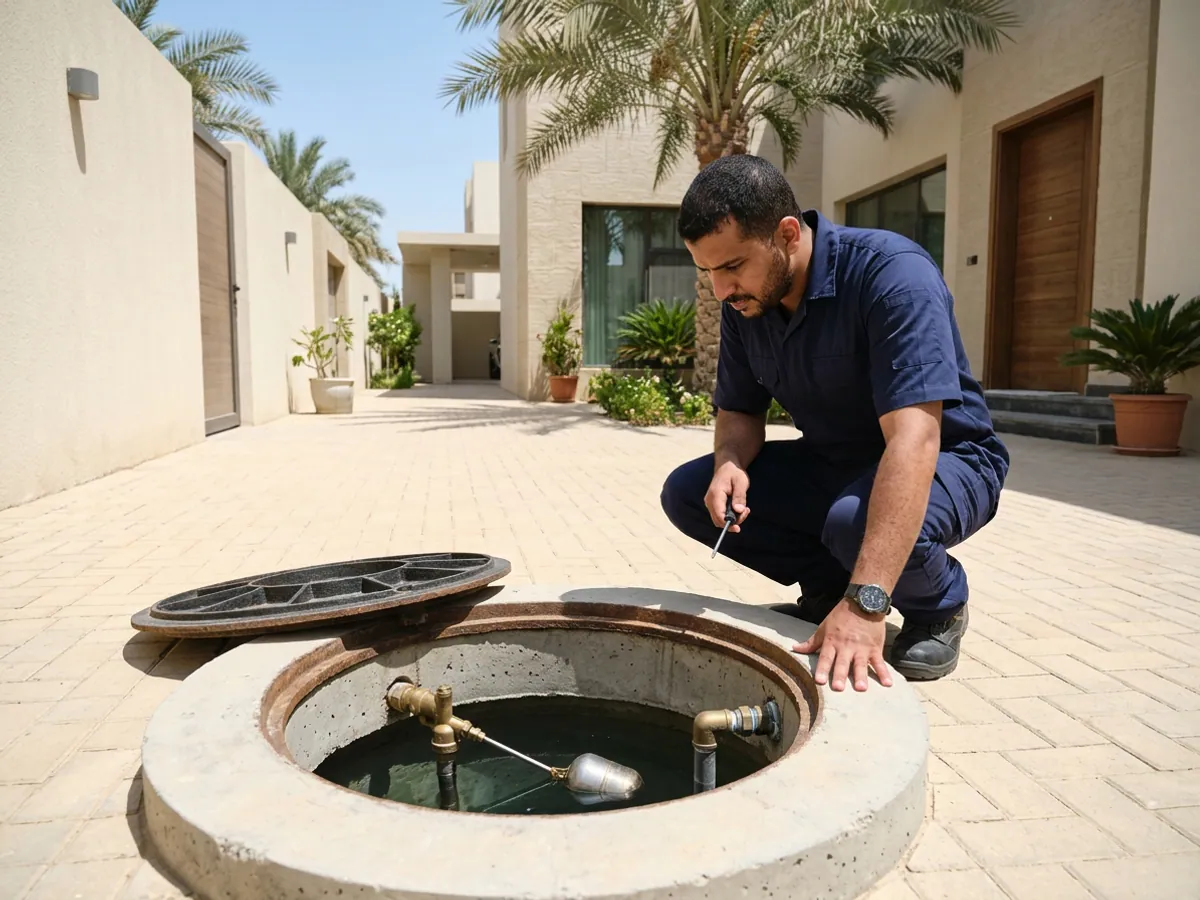
Positive vs. Negative Hydrostatic Pressure in Coastal Eastern Province Tanks
An underground reinforced-concrete tank experiences two opposing hydraulic forces: **Positive Hydrostatic Pressure** when full—pushing the internal lining tightly against concrete walls—and **Negative Hydrostatic Pressure** whenever the tank level drops and surrounding saline groundwater pushes inward through exterior wall pores.
Negative-side groundwater drive explains why single-system epoxy coatings frequently fail in coastal villas: non-breathable epoxy traps migrating soil moisture behind the film, creating osmotic blisters that rupture and flake into stored water. Review full execution protocols on our water tank insulation service page.
- Positive water pressure pins linings onto concrete; negative groundwater pressure pries non-breathable films off.
- Bitumen, cutback primers, and industrial floor epoxies are strictly prohibited inside potable tanks.
- Underground tanks are hazardous confined spaces requiring forced ventilation and trained crews.
Potable Cementitious Slurry vs. Solvent-Free Tank Epoxy vs. Hybrid Dual System
| Engineering Criterion | Certified Potable Cementitious (2K / Crystalline) | Solvent-Free Potable Tank Epoxy | Hybrid Dual System (Cementitious Base + Epoxy) |
|---|---|---|---|
| Bonding Mechanism | Monolithic capillary/chemical bond onto pre-dampened SSD concrete | High surface adhesion requiring dry, mechanically profiled concrete (CSP 3) | Combines deep cementitious pore stabilization with a smooth epoxy top barrier |
| Negative Groundwater Resistance | High—resists external soil dampness without osmotic blistering | Low alone—blisters and delaminates under active negative seepage | High—cementitious base blocks negative vapor drive beneath the cured epoxy |
| Surface Hygiene & Cleanability | Dense mineral finish; slightly micro-textured compared to resin films | Glass-smooth, non-porous surface resisting biofilm and sediment adhesion | Glass-smooth hygienic topcoat ideal for periodic tank washing |
| Hairline Crack Tolerance | Good hairline crack-bridging in 2K flexible polymer-modified grades | Rigid cross-linked film; fractures if underlying substrate cracks move | Reinforced coves and 2K base absorb minor substrate stresses |
| Mandatory Potable Compliance | Must verify potable drinking-water certification on exact product TDS | Must be 100% solvent-free & certified (SASO 2882 / NSF 61 / BS 6920) + full cure | Inter-coat compatibility verified + potable certification on topcoat |
Water Tank Leak Detection vs. Water Tank Waterproofing
Many high-water-bill complaints blamed on "tank walls" actually originate in mechanical float valves, overflow pipes, or unsealed manhole necks:
| Service Dimension | Water Tank Leak Detection (Diagnostic) | Water Tank Waterproofing (Relining) |
|---|---|---|
| When to Request | Unexplained water-bill surge, pump cycling, or dropping water level of unknown cause | Newly cast concrete tank, or existing tank with confirmed wall cracks/peeling lining |
| Technical Scope | Float-valve shutoff check, suction/overflow line testing, neck inspection & drop measurement | Dewatering, forced ventilation, grinding, crack/kicker-joint repair & certified multi-coat lining |
| Outcome for Owner | Pinpoints whether a simple valve/pipe fix solves the loss without draining and relining | Restores long-term structural containment and protects drinking water from ground contamination |
Not sure why your tank is losing water? Start with water tank leak detection or high water bill diagnostics.
Four Critical Red Lines in Underground Water Tank Work
Never Apply Bitumen or Industrial Floor Epoxy Inside Potable Tanks
Bituminous coatings and solvent-borne garage floor epoxies leach toxic hydrocarbons, phenols, and solvents into household water.
Sound Engineering Practice: Verify documented potable-water contact certification (SASO 2882, NSF/ANSI 61, or BS 6920) for the exact product grade before mixing.
Zero Unventilated Entry Into Confined Underground Tanks
Underground tanks are oxygen-deficient confined spaces where fumes or stagnant gases can incapacitate anyone entering casually. Never attempt DIY tank coating.
Sound Engineering Practice: Require continuous mechanical air extraction/supply blowers, PPE, safe lighting, and an external safety attendant.
Never Refill Before Full Multi-Day Chemical Cure & Flushing
Touch-dry epoxy is NOT chemically cured; premature water immersion causes amine blush, softening, and chemical leaching.
Sound Engineering Practice: Observe the full 5–7 day datasheet cure schedule followed by freshwater washing and pump-out before domestic use.
Do Not Neglect the Manhole Neck & Wall-to-Floor Kicker Joint
Surface courtyard wash water and insects enter through unsealed blockwork tank necks even when lower concrete walls are lined.
Sound Engineering Practice: Extend reinforced cementitious waterproofing up the access neck and form a 45° fillet along the floor-to-wall construction joint.
Frequently Asked Questions: Tank Epoxy vs. Cementitious Linings
Essential answers for safe, durable concrete water storage:
Is every blue epoxy sold in hardware stores safe for drinking-water tanks?
No. Blue pigment does not indicate potable safety. Only 100% solvent-free epoxy formulations carrying verified drinking-water contact testing (such as SASO 2882, NSF/ANSI 61, or BS 6920) on their technical datasheet are acceptable.
Why did the previous epoxy lining inside my coastal Dammam/Qatif tank bubble and peel?
Most likely saline groundwater exerted negative-side hydrostatic pressure through the concrete wall behind a standalone epoxy coat, or the slab was damp/insufficiently ground prior to coating. A negative-pressure cementitious base layer resolves that moisture drive.
How long must a newly lined tank cure before refilling with water?
Depending on ambient temperature and product datasheet rules, potable tank linings typically require 5 to 7 days of ventilated curing followed by freshwater rinsing and draining prior to household service.
Can polyethylene or fiberglass rooftop tanks be coated with cementitious slurry or tank epoxy?
No. Structural cementitious and rigid epoxy linings are engineered for concrete substrates and will peel off flexible plastic tanks; plastic tank issues involve plumbing fittings, float valves, or manufacturer replacement.
Have another specific question about your property? Reach us directly by phone or WhatsApp.