Technical Guides & Engineering Comparisons for Property Protection
Built for villa owners, project engineers, and facility managers across the Eastern
Province, these technical guides compare waterproofing chemistries, thermal insulation
assemblies, and potable tank linings objectively—helping you separate marketing myths
from building-envelope physics before commissioning work.
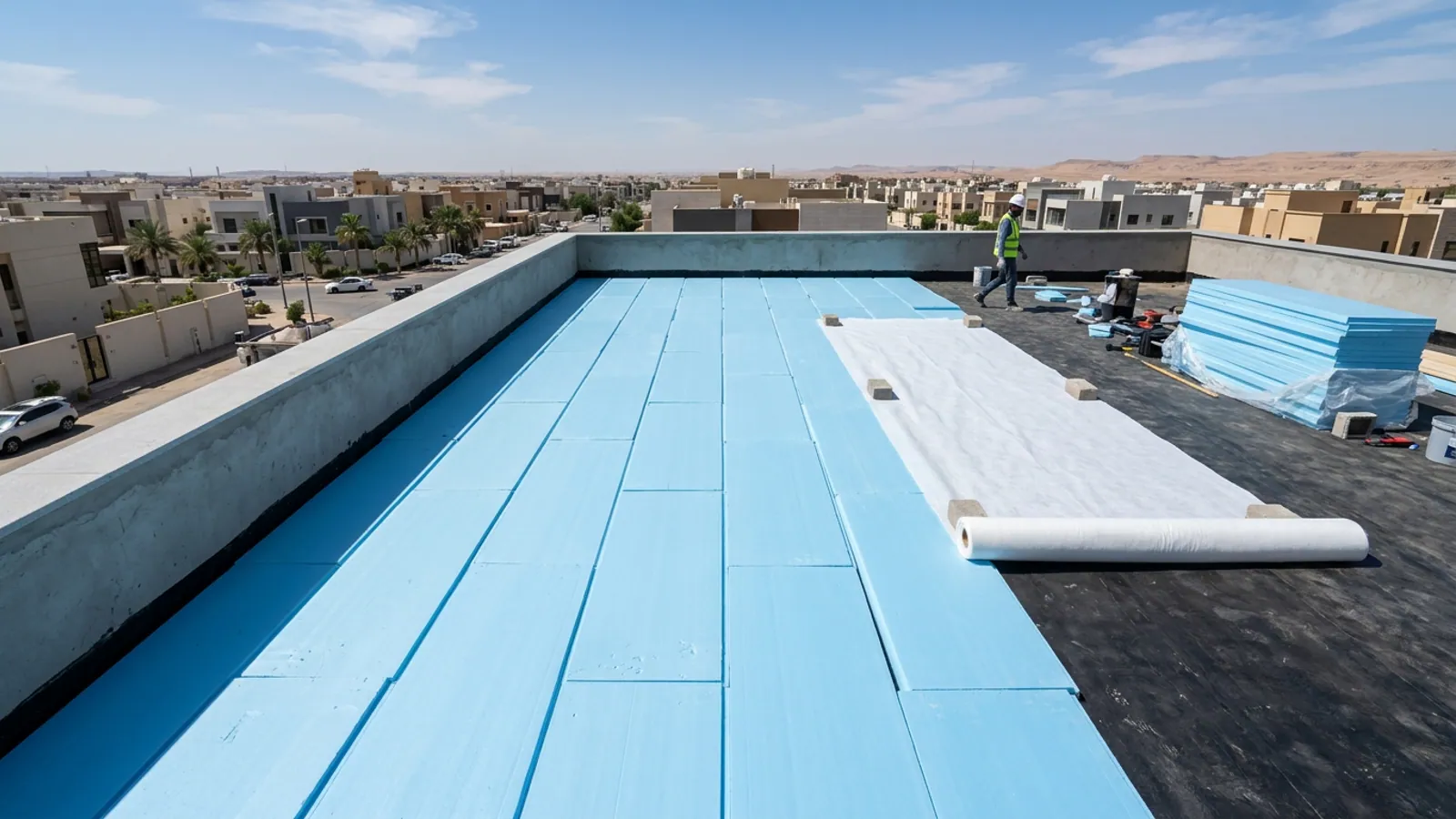
During villa construction or roof renovation in Saudi Arabia, "insulation" (عزل) is frequently used as a catch-all word for both moisture barriers and heat barriers. In building-envelope physics, waterproofing and thermal insulation solve completely different mechanisms—confusing one for the other leaves properties either vulnerable to winter rain damage or exposed to punishing summer heat gain.
Waterproofing blocks liquid water and capillary moisture from reaching structural concrete and steel rebar, but offers negligible thermal resistance.
Thermal insulation slows conductive heat flow (raising R-value aligned with SBC 601/602 principles), yet rigid thermal boards have open joints that cannot stop rainwater.
No single waterproofing chemistry is universally "best" for every roof in Saudi Arabia. The ideal assembly for a newly cast concrete villa deck destined for porcelain pavers differs fundamentally from a corrugated metal warehouse roof or an MEP-congested service deck. This engineering guide compares the four primary material families objectively across Gulf climate realities.
Property owners building or rehabilitating an underground concrete water tank in the Eastern Province frequently ask whether to specify polymer-modified cementitious waterproofing, blue tank epoxy, or a combined dual lining. Along coastal sabkha water tables in Dammam, Khobar, Qatif, and Jubail, applying standalone epoxy over damp walls causes rapid blistering—while choosing uncertified coatings jeopardizes household water safety.
Non-negotiable health rule: any internal domestic tank lining must be solvent-free and hold documented potable-water contact certification (e.g., SASO 2882, NSF/ANSI 61, or BS 6920).
Solvent-free epoxy forms a dense, smooth hygienic barrier under positive internal water pressure, but blisters and peels if negative-side groundwater pushes inward from surrounding wet soil.
Receiving a residential water bill two or three times higher than normal—with zero visible puddles on your floors—is a common frustration across the Eastern Province. This hands-on homeowner guide walks you through progressive tariff math and a 30-minute DIY self-audit to catch simple fixture faults yourself and know exactly when concealed instrument diagnostics is warranted.
Progressive residential tariff tiers mean a modest continuous leak pushes monthly volume into higher-priced brackets, multiplying the SAR invoice faster than volume alone.
Four homeowner-accessible components cause a large share of silent waste: weeping toilet flappers, stuck ground-tank floats, stuck RO filter shutoff valves, and irrigation timers.
Concealed residential plumbing failures rarely announce themselves with a dramatic burst pipe. Far more often, slow pinhole seepage beneath floor screed or behind bathroom porcelain saturates sand bedding quietly for weeks—sending subtle thermal, visual, and odor clues long before plaster collapses. Here is how to spot and interpret those early warning signals room by room.
A localized warm patch on an otherwise cool tiled hallway or bathroom floor is a textbook indicator of a leaking buried hot-water line.
Grout joints that stay dark and damp in one corner hours after the rest of the floor dries point to upward vapor drive from saturated screed.
Across Arabian Gulf coastal cities, villa and building owners frequently repaint flaking ground-floor walls only to watch white salt crystals and blistering return within months. This regional engineering guide explains how saline coastal sabkha soils and high Gulf dew points interact with concrete and masonry—and how to tell environmental moisture apart from concealed plumbing leaks before spending money on the wrong repair.
Coastal cities (Dammam, Al Khobar, Qatif, Jubail) face two non-plumbing moisture drivers: upward capillary wicking of saline groundwater from below, and humid air condensing on cold surfaces above.
Salt crystallization (efflorescence and sub-florescence) expands inside plaster pores with enough mechanical force to pop premium paints off the wall.
When requesting quotes for water leak diagnostics, roof waterproofing, or concrete tank lining in the Eastern Province, property owners often receive widely different numbers with minimal technical detail. This buyer’s guide breaks down the real engineering variables that drive project cost—and shows you how to evaluate contractor proposals on specification depth rather than headline price alone.
For leak diagnostics, inspection effort scales with plumbing complexity—number of tanks, booster pumps, hot/cold manifolds, and affected floors.
For roof and tank waterproofing, mechanical surface preparation, 45° corner detailing, and UV/potable protective coats represent a major share of lasting performance.
How to Use Technical Guides Before Scheduling Inspection
Three engineering checks that prevent incompatible coatings and unnecessary demolition:
01
Separate Active Leaks From Preventive Protection
If your building already shows unexplained dampness or a spiked water bill, verify
whether pressurized plumbing is leaking before sealing the surface beneath new coatings.
02
Match Chemistry to Substrate & Exposure
Bare concrete roofs under tile, exposed metal Shinko roofs, and underground potable
tanks facing saline groundwater each demand completely different membrane physics.
03
Share Clear Site Context on WhatsApp
Sending your building stage, approximate square meterage, and clear photos helps our
Eastern Province team advise on suitable next steps right away.
Core Service Pillars
Connecting Leak Diagnostics With Preventive Envelope Protection
Explore the dedicated commercial service page aligned with your property requirement: