Waterproofing vs. Thermal Insulation: Physical Functions & Correct Roof Layer Order
During villa construction or roof renovation in Saudi Arabia, "insulation" (عزل) is frequently used as a catch-all word for both moisture barriers and heat barriers. In building-envelope physics, waterproofing and thermal insulation solve completely different mechanisms—confusing one for the other leaves properties either vulnerable to winter rain damage or exposed to punishing summer heat gain.
Key Engineering Takeaways
- Waterproofing blocks liquid water and capillary moisture from reaching structural concrete and steel rebar, but offers negligible thermal resistance.
- Thermal insulation slows conductive heat flow (raising R-value aligned with SBC 601/602 principles), yet rigid thermal boards have open joints that cannot stop rainwater.
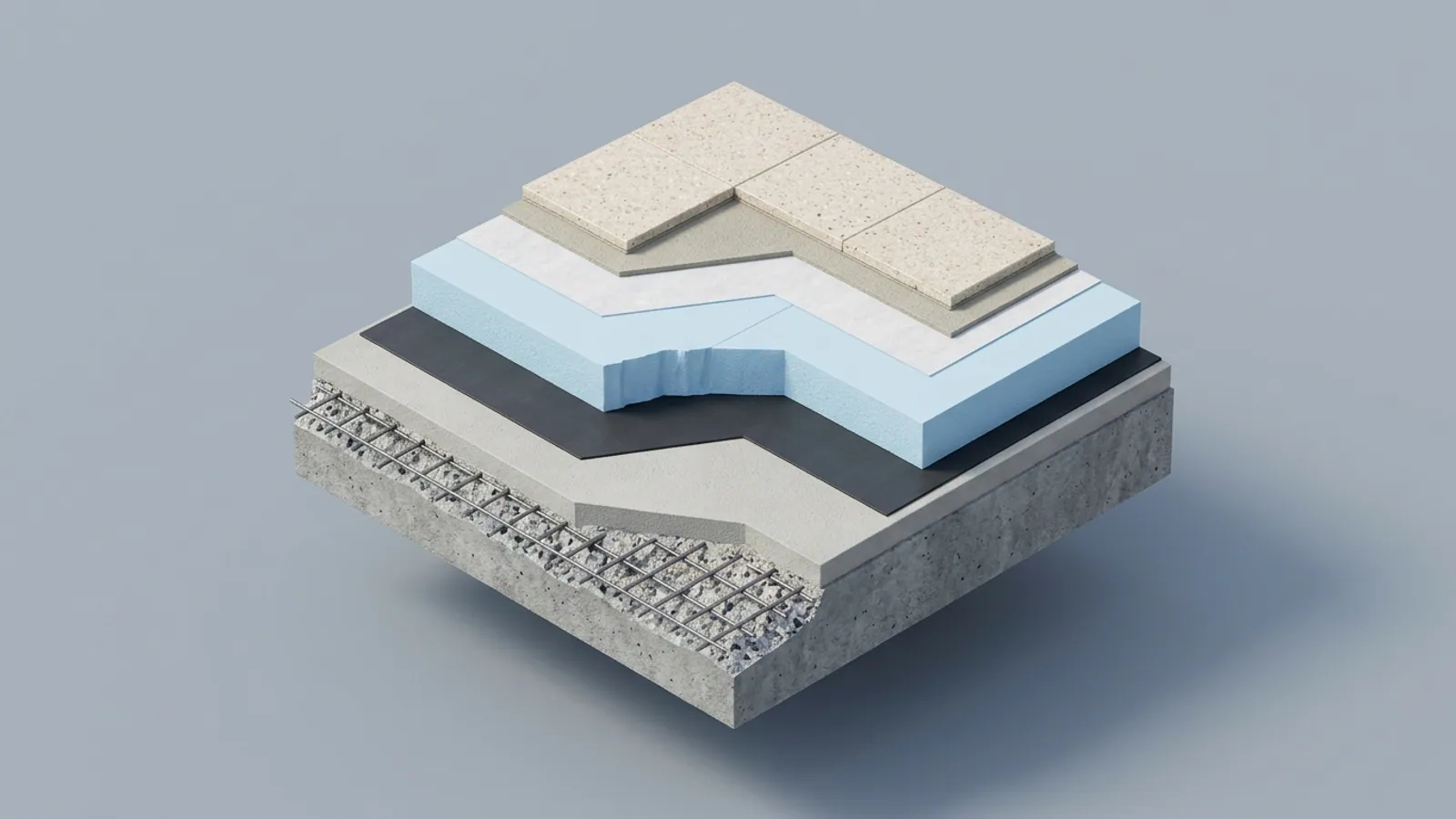
- In an Inverted Protected Membrane Roof, the waterproofing membrane is installed and flood-tested on the sloped slab first, then shielded beneath extruded polystyrene (XPS) thermal boards.
- Thin white solar-reflective coatings lower surface skin temperature (SRI) when clean, but never substitute for bulk thermal insulation thickness.
Why Neither System Substitutes for the Other in Eastern Province Climates
Buildings across Dammam, Khobar, Dhahran, Qatif, and Jubail face dual environmental stress: prolonged summer solar radiation that drives air-conditioning loads, alongside intense seasonal rainstorms and saline coastal humidity that corrode reinforcing steel.
Dedicated waterproofing systems use dense, continuous membranes—such as APP/SBS modified-bitumen rolls, 2K polymer-modified cementitious slurries, or liquid polyurethane coats—to stop hydrostatic and capillary water entry. At 2–4 mm thick, however, dense membranes transmit heat rapidly. Conversely, thermal insulation boards such as extruded polystyrene (XPS) trap microscopic closed gas cells across 50–100 mm thicknesses to resist conductive heat transfer, yet rainwater flows freely between individual board joints straight down to the slab unless a continuous waterproof barrier sits underneath.
- Bitumen membrane alone = reliable rain barrier + negligible heat resistance.
- Rigid XPS boards alone = strong heat resistance + open joints that pass rainwater.
- Combining both layers properly protects structural concrete while stabilizing indoor comfort.
Waterproofing vs. Thermal Insulation vs. Composite Spray Foam Systems
| Engineering Dimension | Standalone Waterproofing | Standalone Thermal Insulation (Boards) | Closed-Cell SPF + UV Topcoat |
|---|---|---|---|
| Primary Physical Function | Blocks liquid water seepage and hydrostatic moisture | Retards conductive heat transfer across roofs/walls (R-value) | Combines seamless thermal resistance + rain shedding in one assembly |
| Representative Materials | APP/SBS bitumen sheets, 2K cementitious slurry, liquid PU, potable tank epoxy | Extruded polystyrene (XPS), mineral/rock wool, polyisocyanurate (PIR) boards | Rigid closed-cell spray polyurethane foam (ASTM C1029) + elastomeric UV coat |
| Building Zones Served | Roofs, underground/elevated concrete water tanks, bathrooms, wet kitchens | Flat concrete roofs, metal roofs, exterior walls (never inside water tanks) | Suitable exposed concrete roofs and corrugated metal (Shinko) roofs |
| Stops Rainwater Leaks Alone? | Yes, when seams, cant strips, and drains are properly detailed | No—water flows freely through board joints to the slab below | Yes on positively sloped decks ONLY when sealed with an intact UV topcoat |
| Reduces Conductive Heat Gain Alone? | No—thin membranes provide negligible bulk R-value | Yes—engineered specifically for bulk thermal resistance | Yes—continuous closed-cell core eliminates board-joint thermal bridges |
| Relevant Standards Context | ASTM D5147 / ANSI A118.10 / SASO 2882 | Saudi Building Code SBC 601 & SBC 602 principles / ASTM C578 | ASTM C1029 + SBC 201 / IBC Ch. 26 fire-barrier rules |
We never advertise guaranteed fixed electricity-bill percentage savings because whole-building cooling demand also depends on glazing, wall assemblies, air leakage, and HVAC efficiency.
Which Layer Goes First on a Saudi Flat Roof: Waterproofing or Thermal Boards?
For flat concrete villa and commercial roofs in Saudi Arabia, modern building practice favors the **Inverted (Protected Membrane) Roof Assembly**:
1. Inverted Protected Roof Order (Waterproofing First, XPS Thermal Above)
First, sloped screed is cast toward roof drains; second, the primary waterproofing membrane (such as APP/SBS modified-bitumen rolls) is installed with 45° cant strips and flood-tested; third, a separation geotextile and closed-cell XPS thermal boards are laid above the membrane, topped by a filter fleece and tiles or washed gravel ballast. Placing XPS above the membrane shields the waterproofing from extreme thermal shock, UV degradation, and foot-traffic punctures.
2. Seamless Composite Option (Closed-Cell SPF + Mandatory UV Shield)
On exposed concrete decks crowded with AC plinths or lightweight corrugated metal roofs where heavy tile ballast is undesirable, closed-cell polyurethane spray foam adheres directly to the clean dry deck and is immediately sealed with an elastomeric UV protective topcoat.
3. Why Thin "Reflective Paint" Is Not Bulk Thermal Insulation
Sub-millimeter white acrylic roof paints improve initial solar reflectance (SRI) but lose reflectivity rapidly under desert dust accumulation and provide virtually zero conductive R-value once outdoor air temperatures exceed 42°C.
Four Field Mistakes to Avoid When Combining Waterproofing & Thermal Layers
Laying XPS Polystyrene Directly Over Wet Solvent-Based Bitumen Primer
Volatile petroleum solvents dissolve polystyrene cells and deform board edges.
Sound Engineering Practice: Allow full cure, complete flood testing, and install a compatible non-woven geotextile separation layer beneath XPS boards.
Installing Blue Thermal Foam Boards Over Bare Concrete Without Waterproofing
Rainwater bypasses board joints and stays trapped beneath the foam against bare concrete for weeks, causing persistent ceiling leaks.
Sound Engineering Practice: Always install and test a continuous [roof waterproofing membrane](/en/services/roof-insulation/) underneath rigid thermal boards.
Leaving Rigid Polystyrene Boards Unballasted and Exposed to Sun
Uncovered XPS chalks under UV sunlight, blows loose in high winds, and floats during heavy downpours.
Sound Engineering Practice: Cover XPS with filter geotextile and secure beneath pavers, mortar-set tiles, or washed gravel ballast.
Confusing Interior Thermal-Bridge Condensation With Rainwater Leaks
Uninsulated concrete roof beams cooled by indoor AC can condense humid indoor air into corner mold even during dry summer months.
Sound Engineering Practice: Use [moisture & dampness diagnostics](/en/services/moisture-dampness-diagnostics/) to distinguish condensation bridges from active roof leaks.
Frequently Asked Questions: Waterproofing vs. Thermal Insulation
Practical answers for villa owners and project managers:
Do bathrooms and underground water tanks need thermal insulation or waterproofing?
Bathrooms, wet kitchens, and concrete water tanks require specialized waterproofing systems to contain liquid water; thermal insulation applies to exterior building-envelope roofs and walls.
Does closed-cell spray polyurethane foam replace separate bitumen rolls and XPS boards?
On suitable exposed roofs and metal decks where heavy tiled finishes are not planned, closed-cell SPF topped with a maintained elastomeric UV coating fulfills both roles. For heavily trafficked tiled villa roofs, an inverted APP/SBS membrane + XPS + tile assembly is often preferred.
Why place XPS thermal boards above the waterproofing membrane instead of below it?
Placing moisture-resistant XPS above the membrane keeps the waterproofing at a stable temperature year-round, shields it from UV rays, and prevents mechanical punctures during tiling.
How can we confirm which roof assembly fits our property in the Eastern Province?
Share your building stage (new concrete slab vs. existing tiled/exposed roof) and location via WhatsApp or phone so our team can review compatible options.
Have another specific question about your property? Reach us directly by phone or WhatsApp.