Factory-Gauged Sheet Membranes & Bituminous Systems · Eastern ProvinceEastern Province — Concrete Roof & Protected Slab Membranes
Bituminous Coatings & Sheet Membrane Waterproofing Systems
Polymer-modified bituminous roll membranes (APP and SBS) remain a cornerstone of flat concrete roof waterproofing in Saudi Arabia thanks to factory-controlled thickness and internal polyester reinforcement. Below we explain how liquid bitumen primers/emulsions differ from reinforced roll sheets, how lap seams and parapets are detailed, and strict safety boundaries.
Liquid Bitumen Emulsions vs. Reinforced APP & SBS Roll Membranes
Property owners often hear "bitumen waterproofing" used for two very different products: cold-applied liquid bituminous emulsions and factory-manufactured modified-bitumen roll sheets. Thin unreinforced cold bitumen paint serves primarily as a concrete primer or protected damp-proofing coat against soil moisture—it lacks the uniform film build and tensile carrier needed to span movement cracks on an exposed villa roof.
Reinforced modified-bitumen sheet membranes (typically 4 mm nominal thickness for roofing) embed a non-woven spunbond polyester carrier inside bitumen modified either with APP (atactic polypropylene) for superior high-temperature stability in Gulf summers, or SBS (styrene-butadiene-styrene) synthetic rubber for high elastic recovery per ASTM D5147 categories.
APP plastomeric sheets: high softening point well suited to hot Saudi rooftops in roof waterproofing.
SBS elastomeric sheets: superior cold/movement elongation beneath protected inverted roof assemblies.
Cold rubberized bitumen emulsions: effective primers and protected damp-proofing coats, not standalone roof sheets.
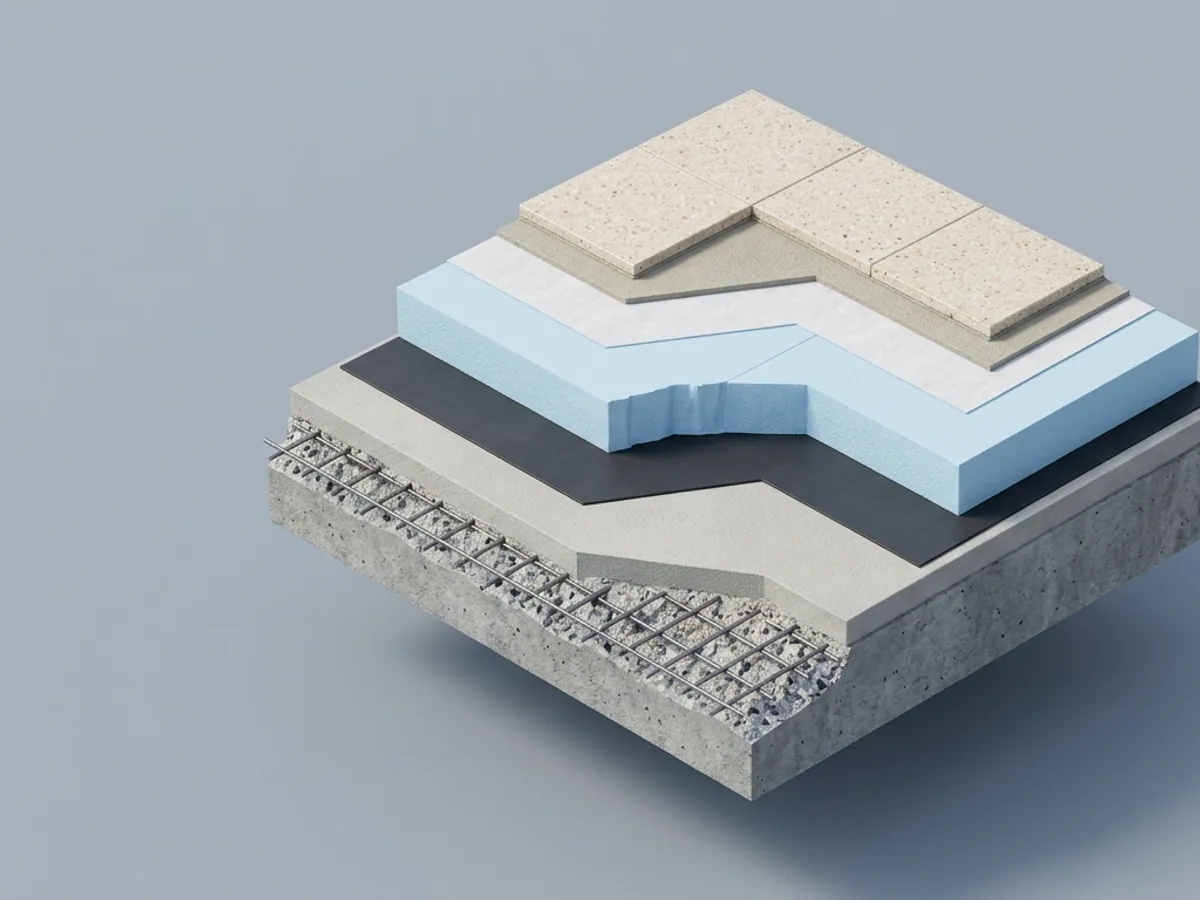
Bituminous membranes block water only; combine with XPS boards for thermal insulation.
Educational Technical Illustration
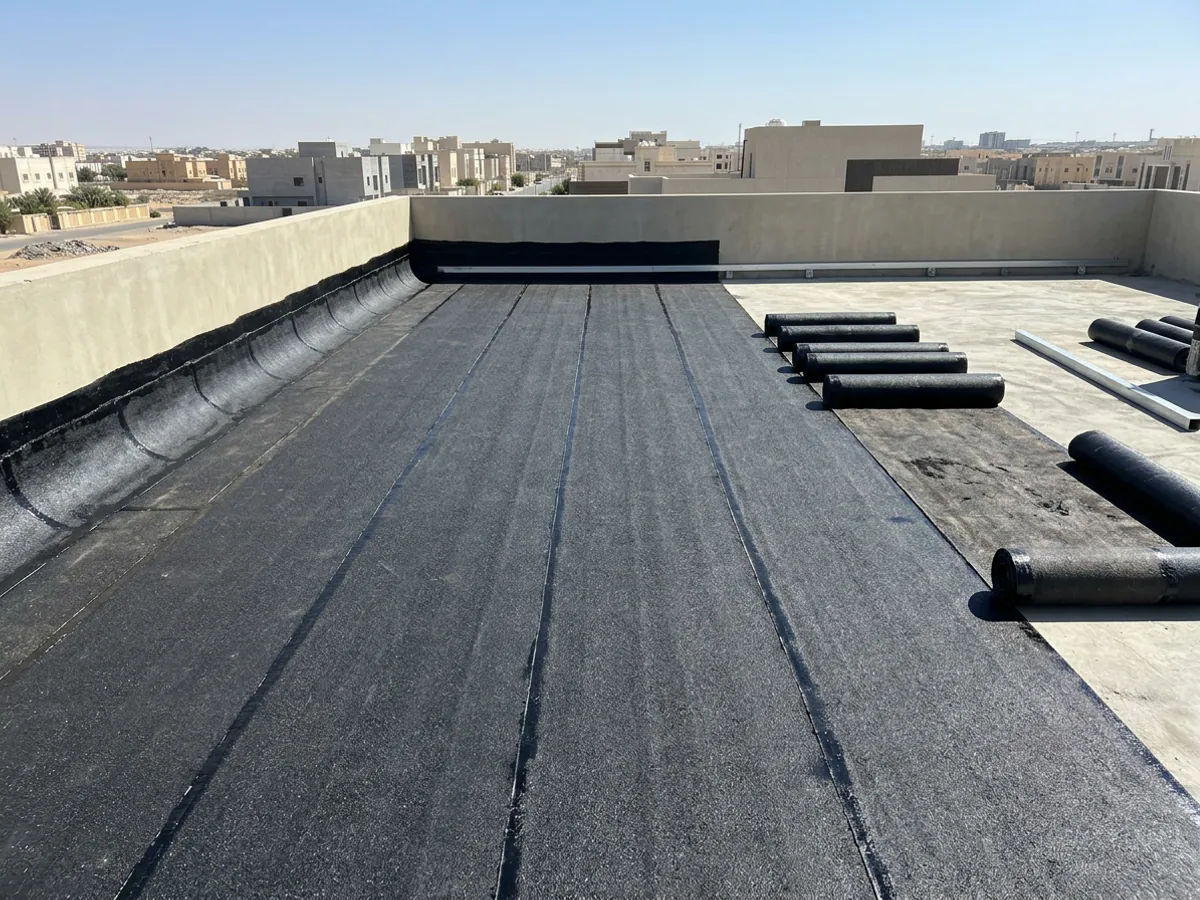
Aligned modified-bitumen sheet membranes with uniform 10 cm side laps and staggered end joints.
Bituminous System Comparison
Cold Liquid Bitumen vs. APP Sheets vs. SBS Sheets
Technical comparison across cold liquid bitumen emulsions, APP plastomeric sheets, and SBS elastomeric sheets
Grind away sharp nibs, vacuum dust, verify concrete dryness (trapped moisture prevents primer bond), and trowel 45-degree cant strips along all parapet and curb bases.
Consequence if Skipped: Vapor blisters beneath the roll and membrane splitting along sharp 90-degree corners.
2
Bituminous Primer Coat & Tack-Free Flash-Off
Apply compatible bituminous primer evenly across horizontal screed and parapet upturns to seal concrete pores, allowing full flash-off before laying rolls.
Consequence if Skipped: Weak peel adhesion and trapped solvent/water vapor pockets.
3
Shingle-Fashion Roll Layout From Low Drains Upward
Unroll sheets starting at the lowest rainwater gullies working upslope so water flows over—never against—10 cm side laps and 15 cm staggered end laps.
Consequence if Skipped: Back-watered lap edges allow stormwater infiltration under hydrostatic head.
Carry mineral-surfaced cap flashings up parapets into chased reglet grooves with termination bars/sealant, and cover horizontal sheets with non-woven geotextile plus screed or XPS boards.
Consequence if Skipped: Mechanical punctures from follow-on tiling trades or sagging parapet edges in summer heat.
Bituminous hydrocarbons taint water odor/taste and are never approved for domestic drinking-water immersion.
Sound Engineering Practice: Use certified cementitious and solvent-free potable epoxy systems on our [water tank waterproofing page](/en/services/water-tank-insulation/).
Mandatory Safety Boundary
Thermal Fusion Fire Safety — Zero DIY Open-Flame Work
Heat-welded roll systems pose fire hazards near combustible insulation, gas lines, or electrical conduits if mishandled; sensitive zones require cold-adhesive or self-adhered sheets.
Sound Engineering Practice: Restrict installation to trained crews with fire extinguishers and hot-work controls—never attempt DIY torch heating.
Material Engineering Limit
Not Ideal for Direct Thin-Set Tiling in Compact Bathrooms
Smooth bitumen rejects cementitious tile adhesives without an intermediate mortar bed and is cumbersome in tight shower corners.
Uncured petroleum solvents dissolve XPS/EPS thermal insulation boards on contact.
Sound Engineering Practice: Wait for full cure and separate waterproofing from XPS boards with a non-woven geotextile fleece.
Scope & Cost Variables
Factors Influencing Bitumen & Membrane Scope
Project scope is determined by four structural variables:
Single-Ply vs. Two-Ply Specification & Carrier Weight
4 mm single-layer assemblies vs two-ply cross-lapped systems and mineral-slate cap sheets.
Screed Readiness & Cant-Strip Preparation
Condition of sloped concrete screed, crack repairs, and perimeter reglet chasing.
Penetration Density & Parapet Perimeter Ratio
Cutting, collar reinforcing, and overlap waste around dense rooftop equipment bases.
Geotextile Separation & Protective Screed Layers
Inclusion of protective separation fleeces prior to thermal boards or tiling.
Reach out via phone or WhatsApp with your roof stage and Eastern Province location for clear technical guidance.
Scope Clarity & Transparency
Detail-Oriented Membrane Standards at Manar Al Sharqiya
Controlled Seam Overlap & Upslope Shingling
Laps are aligned with drainage slopes and staggered so corners never stack four-ply bulges.
Immediate Protection Against Trade Damage
Emphasizes geotextile fleece and protective toppings so follow-on trades do not puncture new sheets.
Objective Comparison Against Alternatives
We clarify honestly whether APP/SBS sheets, cementitious slurries, or UV-coated foam best match your deck.
Eastern Province Service Coverage
Bitumen & Sheet Membrane Inquiries in the Eastern Province
Building a new villa or renewing a flat concrete roof in the Eastern Province? Contact Manar Al Sharqiya via phone or WhatsApp to review membrane specifications.
Frequently Asked Questions About Bitumen & Roll Membranes
Are APP or SBS modified-bitumen membranes better for hot Saudi roofs?
+
APP plastomeric membranes offer higher softening-point resistance under intense Saudi rooftop temperatures, whereas SBS elastomeric membranes provide higher stretch recovery beneath well-shaded inverted roof assemblies.
Can cold liquid bitumen paint replace 4 mm roll membranes on a main villa roof?
+
Generally no. Thin unreinforced cold bitumen emulsions lack uniform thickness and internal polyester reinforcement needed to resist thermal deck movement and standing rainwater.
Can smooth black bitumen membranes remain exposed to direct sunlight?
+
Smooth polyethylene-filmed sheets must be covered with geotextile and screed, tiles, or inverted XPS boards; exposed vertical parapet flashings require mineral-slate-surfaced cap sheets.
What overlap width is required between sheet membrane rolls?
+
Standard practice specifies approximately 10 cm side-lap overlaps and 15 cm staggered end-lap overlaps laid upslope from roof drains.
Can bituminous membranes be used inside domestic drinking-water tanks?
+
Never. Bituminous products are non-potable and strictly prohibited inside drinking-water storage—see water tank waterproofing.
Why is a bituminous primer necessary on bare concrete before laying rolls?
+
Primer penetrates concrete capillaries and binds microscopic surface dust so the sheet membrane achieves full adhesive bond rather than lifting in summer heat.
How do I inquire about sheet membrane waterproofing for my project?
+
Call or WhatsApp 0590941982 with your project stage (bare slab vs sloped screed) and location in the Eastern Province.
Have another specific question about your property? Reach us directly by phone or WhatsApp.
Technical waterproofing services across the Eastern Province, Saudi Arabia for roofs, water tanks, and wet areas. Substrate-matched membrane systems. Call 0590941982.
Flat concrete, tiled, and metal roof waterproofing systems in the Eastern Province. Positive drainage detailing, parapet flashings, and membrane selection. Call 0590941982.
Diagnose blistered, cracked, or delaminated waterproofing membranes and determine whether localized repair or full replacement is required. Call 0590941982.